Jobs in Dubai 2026: Opportunities Across Sectors
Dubai’s job market in 2026 is defined by scale, speed, and diversification. Within the first glance, job seekers will find opportunities spanning construction, hospitality, logistics, healthcare, retail, and an increasingly influential technology sector. The emirate’s economic model—built on foreign labor, global trade, and ambitious infrastructure—continues to generate thousands of new roles annually, making it one of the most dynamic employment hubs in the Middle East.
For workers worldwide, including those from South Asia and Africa, Dubai offers comparatively higher wages, tax-free income, and access to international work environments. In the first 100 words alone, the key takeaway is clear: Dubai remains a top destination for multi-sector employment due to its strong economic growth, mega-projects, and business-friendly policies.
In 2026, demand is no longer limited to low- and mid-skilled roles. The rise of artificial intelligence, fintech, and smart-city initiatives has expanded opportunities for engineers, analysts, and digital specialists. Yet traditional sectors—construction, transport, and tourism—continue to employ the largest share of workers.
This article explores the landscape of multiple jobs in Dubai, examining where opportunities are growing, what salaries look like, and how workers can navigate this fast-moving labor market.
The Economic Engine Behind Job Growth
Dubai’s employment boom is tied closely to its economic diversification strategy. Historically dependent on oil revenues, the emirate shifted toward trade, tourism, aviation, and finance decades ago. By 2026, non-oil sectors account for more than 70 percent of GDP, according to government estimates.
Major infrastructure developments—such as smart city expansions, logistics corridors, and real estate megaprojects—continue to drive job creation. The government’s long-term plans, including the UAE Vision 2031, emphasize innovation, sustainability, and digital transformation.
Economist Dr. Nasser Saidi notes, “Dubai’s labor market reflects a hybrid economy—part industrial, part digital, and deeply globalized.” This hybrid nature explains why both blue-collar and highly specialized roles are growing simultaneously.
Foreign workers make up nearly 85–90 percent of the workforce, a figure that underscores Dubai’s reliance on international talent. For job seekers, this means fewer barriers to entry compared to many Western economies, though competition remains intense.
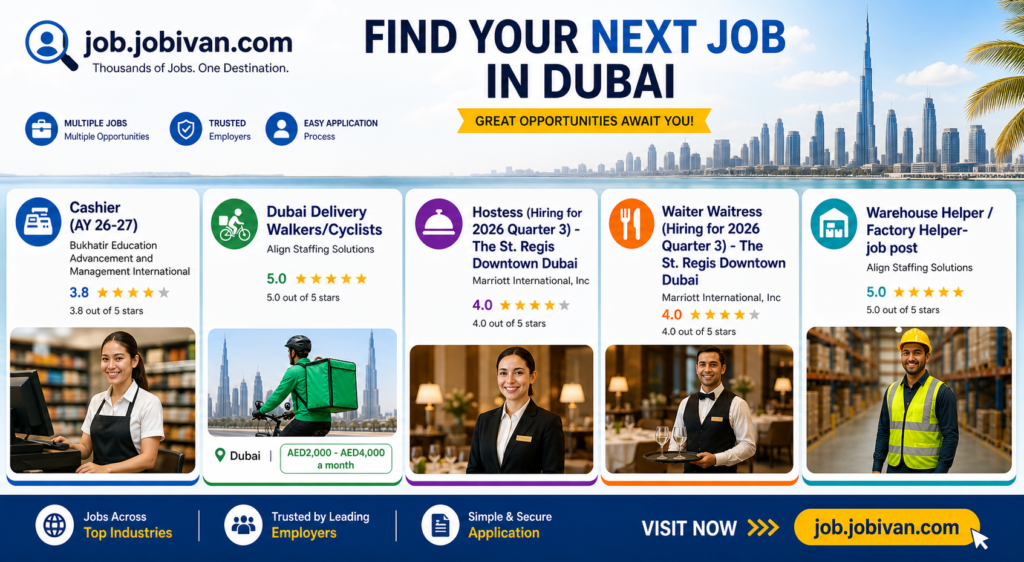
Companies & Job Info
Warehouse Helper / Factory Helper- job post
5.05.0 out of 5 stars
Waiter Waitress (Hiring for 2026 Quarter 3) – The St. Regis Downtown Dubai
4.04.0 out of 5 stars
Hostess (Hiring for 2026 Quarter 3) – The St. Regis Downtown Dubai
4.04.0 out of 5 stars
Delivery Walkers/Cyclists
5.05.0 out of 5 stars
Dubai
AED2,000 – AED4,000 a month
Cashier (AY 26-27)
Bukhatir Education Advancement and Management International
3.83.8 out of 5 stars
Dubai
Apply Now || Apply Now || Apply Now || Apply Now ||
Key Sectors Offering Multiple Jobs in 2026
Dubai’s job market is not dominated by a single industry. Instead, employment is distributed across several high-demand sectors, each evolving at a different pace.
Major Job Sectors in Dubai (2026)
| Sector | Common Roles | Demand Level | Salary Range (Monthly AED) |
|---|---|---|---|
| Construction | Laborers, engineers, supervisors | Very High | 1,200 – 12,000 |
| Hospitality | Waiters, cleaners, hotel staff | High | 1,500 – 6,000 |
| Logistics | Drivers, warehouse workers | High | 2,000 – 7,000 |
| Healthcare | Nurses, technicians, doctors | Growing | 4,000 – 25,000 |
| Technology | Developers, analysts, IT managers | Rapid Growth | 8,000 – 30,000 |
| Retail | Sales associates, cashiers | Moderate | 2,000 – 5,000 |
The construction sector remains the largest employer, fueled by continuous real estate development. However, technology and healthcare are the fastest-growing, reflecting broader global trends.
Construction and Infrastructure: The Backbone of Employment
Construction continues to dominate Dubai’s labor market in 2026. Massive projects—from luxury residential towers to transportation systems—require a steady influx of workers.
Laborers, electricians, plumbers, and heavy machinery operators form the backbone of this sector. Engineers and project managers are also in high demand, particularly those with international experience.
According to industry analyst Farah Al-Mazrouei, “Dubai’s construction sector is unique because it rarely slows down. Even during global downturns, strategic projects continue.”
Wages in this sector vary widely. While entry-level laborers may earn modest salaries, skilled professionals can command significantly higher pay. Accommodation and transportation are often provided, reducing living costs for workers.
Despite opportunities, challenges remain. Long working hours, harsh weather conditions, and strict deadlines are common realities in this field.
Hospitality and Tourism: A Global Service Hub
Dubai’s reputation as a global tourism destination ensures a steady demand for hospitality workers. Hotels, restaurants, and entertainment venues collectively employ hundreds of thousands of people.
Roles range from housekeeping and front desk operations to culinary positions and management. Events such as international expos, festivals, and conferences further boost employment needs.
Hospitality expert Lina Khatib explains, “Dubai’s service standards are among the highest globally, which means continuous hiring and training.”
While salaries in hospitality are generally lower than in technical fields, benefits such as accommodation, meals, and tips can significantly enhance overall earnings.
The sector also offers upward mobility. Many workers start in entry-level roles and gradually move into supervisory or managerial positions.
Logistics and Transport: The Trade Gateway
Dubai’s strategic location between Europe, Asia, and Africa makes it a global logistics hub. Ports, airports, and free zones create a constant demand for transport and supply chain workers.
Truck drivers, delivery personnel, warehouse staff, and logistics coordinators are among the most sought-after roles. The rise of e-commerce has further accelerated demand in this sector.
Logistics Growth Indicators
| Year | E-commerce Growth (%) | Logistics Jobs Created |
|---|---|---|
| 2022 | 12% | 15,000 |
| 2024 | 18% | 22,000 |
| 2026 | 25% (est.) | 30,000+ |
Industry consultant Ahmed Rahman notes, “Logistics is no longer just about transport—it’s about data, efficiency, and speed.”
This transformation has created new roles in supply chain analytics and automation, blending traditional labor with digital expertise.
Technology and Innovation: The New Frontier
Dubai’s push toward becoming a smart city has fueled rapid growth in the technology sector. Artificial intelligence, blockchain, and fintech are key focus areas.
Companies are actively hiring software developers, cybersecurity experts, data scientists, and IT project managers. Government initiatives, such as digital transformation programs, have further accelerated demand.
Tech salaries are among the highest in Dubai, reflecting the global competition for skilled professionals. Many firms also offer flexible work arrangements and performance-based incentives.
However, competition is intense. Candidates with international certifications and experience have a significant advantage.
Healthcare: Expanding with Population Growth
As Dubai’s population continues to grow, so does the need for healthcare services. Hospitals, clinics, and specialized medical centers are expanding rapidly.
Nurses, lab technicians, pharmacists, and doctors are in high demand. The COVID-19 pandemic highlighted the importance of a robust healthcare system, leading to increased investment in this sector.
Healthcare consultant Dr. Aisha Khan states, “Dubai is positioning itself as a regional medical hub, which means sustained demand for skilled professionals.”
Licensing requirements can be strict, but the rewards include competitive salaries and job stability.
Work Conditions and Labor Policies
Dubai’s labor market operates under a structured legal framework designed to regulate employment relationships. Contracts, working hours, and wages are governed by UAE labor laws.
Recent reforms have improved worker protections, including mandatory wage payment systems and enhanced dispute resolution mechanisms.
However, challenges remain. Worker advocacy groups have highlighted issues such as delayed payments and contract disputes. The government has responded with stricter enforcement and penalties.
For job seekers, understanding employment contracts and rights is essential before accepting any offer.
Cost of Living vs. Salary Reality
While Dubai offers tax-free income, the cost of living can be high. Housing, transportation, and food expenses vary depending on lifestyle and location.
Low-income workers often rely on employer-provided accommodation to manage costs. Mid- and high-income professionals have more flexibility but face higher expenses.
Financial planner Omar Siddiqui advises, “Earning in Dubai can be lucrative, but savings depend heavily on spending habits.”
Balancing income and expenses is crucial for long-term financial stability.
Takeaways
- Dubai’s job market in 2026 spans multiple sectors, offering opportunities for both skilled and unskilled workers.
- Construction, hospitality, and logistics remain the largest employers.
- Technology and healthcare are the fastest-growing sectors.
- Salaries vary widely, with tax-free income as a major attraction.
- Cost of living can offset earnings if not managed carefully.
- Labor laws have improved, but workers must understand their rights.
Conclusion
Dubai’s labor market in 2026 reflects a city constantly reinventing itself. From towering construction projects to cutting-edge technology hubs, the emirate offers a spectrum of employment opportunities unmatched in much of the world. For millions of workers, it represents not just a job, but a chance at upward mobility and international experience.
Yet the promise of Dubai comes with complexity. High living costs, competitive hiring processes, and demanding work environments require careful planning and resilience. The city rewards those who adapt quickly and bring relevant skills to the table.
As Dubai continues to expand its economic horizons, the diversity of jobs will only increase. For job seekers willing to navigate its challenges, the city remains one of the most compelling employment destinations of the 21st century.
FAQs
1. What are the most in-demand jobs in Dubai in 2026?
Construction workers, drivers, hospitality staff, healthcare professionals, and IT specialists are among the most in-demand roles.
2. Is it easy for foreigners to get jobs in Dubai?
Yes, Dubai actively hires foreign workers, but competition can be high depending on the industry and skill level.
3. What is the average salary in Dubai?
Salaries vary widely, ranging from AED 1,200 for labor roles to over AED 30,000 for specialized professionals.
4. Are jobs in Dubai tax-free?
Yes, personal income is generally tax-free, which is a major advantage for workers.
5. What are the main challenges of working in Dubai?
High living costs, strict work conditions in some sectors, and the need to adapt to a fast-paced environment.