Dairy Farm Jobs in Australia with Visa Sponsorship 2026
Dairy Farm Jobs in Australia with Visa Sponsorship 2026 As of 2026, Australia continues to face significant labor shortages in its regional and rural agricultural sectors, making dairy farming one of the most accessible pathways for foreign workers seeking visa sponsorship and permanent residency.
Because the industry is vital to the Australian economy, the government has specific immigration frameworks in place to help employers bring in overseas talent. Here is a complete guide to securing a visa-sponsored dairy farm job in Australia in 2026.
1. The Dairy Industry Labour Agreement (DILA)
The most important thing to know is that Australia has a specific Dairy Industry Labour Agreement (DILA).1 This is a formal, government-approved arrangement that allows eligible Australian dairy farmers to sponsor skilled overseas workers for roles they cannot fill locally.1
Through the DILA, employers can sponsor you for the following visas:
- Subclass 482 (Temporary Skill Shortage Visa): Allows you to live and work in Australia for up to 4 years.123
- Subclass 494 (Skilled Employer Sponsored Regional Visa): A 5-year visa that mandates living in a regional area.
- Subclass 186 (Employer Nomination Scheme): A direct pathway to Permanent Residency (PR) after a 3-year transition period of working on the farm.2
Eligible Job Titles under DILA: Sponsorship is generally restricted to specific skilled titles, most notably Dairy Cattle Farm Operator and Senior Dairy Cattle Farm Worker.
2. General Duties and Responsibilities
If you are sponsored as a farm operator or senior worker, your daily duties will go beyond entry-level labor. They typically include:
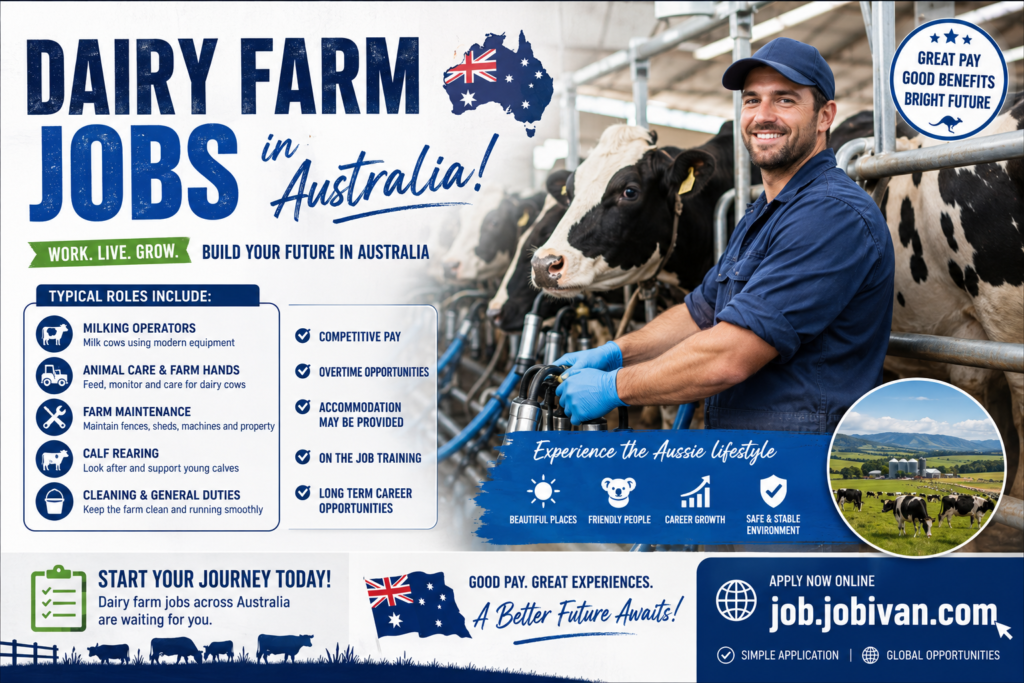
- Operating milking machinery and managing daily milking schedules.
- Calf rearing, feeding, and monitoring herd health.
- Assisting with veterinary procedures (e.g., calving, administering medications).
- Operating heavy farm machinery (tractors, feed mixers, irrigation systems).
- Maintaining farm hygiene and cleaning equipment.
3. Requirements for Visa Sponsorship
To be legally sponsored by an Australian dairy farm, you must meet the specific requirements set by the Department of Home Affairs:
- Work Experience or Qualifications: You typically need at least 1 to 3 years of recent, relevant experience working on a dairy farm.2 Alternatively, an AQF Certificate II or III in Agriculture (or your home country’s equivalent) can sometimes substitute for experience.
- English Language: You must have “Competent English.”2 Under the DILA, this usually means an overall IELTS score of 5.0 (with no minimum component score required).
- Age Limits: There is no age limit for the temporary 482 visa.12 However, if you want to transition to Permanent Residency (the 186 or 494 visas), you generally need to be under 45. (Note: The DILA does offer age concessions allowing workers up to age 55 in certain regional postcodes).
- Driver’s License: A valid driver’s license (preferably an international license or one that can be converted to an Australian one) is almost always mandatory.
- Physical Fitness: You must pass health checks to prove you are physically capable of manual, outdoor labor.
4. Salary and Benefits in 2026
In Australia, sponsored workers must be paid according to the Temporary Skilled Migration Income Threshold (TSMIT).4
- Salary: The minimum salary for a sponsored worker is generally $70,000 AUD per year (approx. $28–$35 AUD per hour). However, under the DILA, farms in highly regional areas can apply a 10% concession, meaning the absolute minimum you might be paid is $63,000 AUD per year.
- Perks: Dairy farms are located in rural areas, so employers frequently provide on-farm accommodation (either free or heavily subsidized), a farm vehicle for work use, and sometimes subsidized meat or milk.
Specific Companies & Farms Sponsoring in 2026
While massive corporations (like Aurora Dairies) often require you to already have Australian working rights, mid-sized, family-owned, or vertically integrated farming companies are highly active in providing visa sponsorship under the Dairy Industry Labour Agreement.
Here are actual companies currently operating and hiring overseas workers:
- The Little Big Dairy Company (Dubbo / Central NSW): A prominent single-source dairy brand that actively hires overseas workers. They frequently advertise roles for Dairy Farmers, Farm Workers, and Dairy Processors (factory workers packing and processing milk). They seek candidates with at least 2 years of full-time experience or a Certificate III in Agriculture.
- Blanch Dairy Co (Rosewood / Brisbane Region, QLD): A progressive family-owned dairy farm.12 They hire Dairy Farm Hands focusing on machinery operation, milking, cropping, and irrigation.123
- Midfield Meat International / Midfield Group (Warrnambool, VIC): While famous for meat processing, they own massive dairy operations in Victoria. They actively recruit Dairy Cattle Farm Operators to run their dairy recycling systems, heavy machinery, and milking sheds. They specifically look for candidates with an AQF Certificate II or III in Agriculture.
- Western Australia Dairy Collectives (Scott River, Warnerglen, and Dardanup, WA): Several large farm conglomerates in Western Australia rely heavily on migration agents (like Visa Go Australia) to fill roles.4 These groups operate 50-to-60-stand rotary dairies milking thousands of cows and offer direct 482 visa sponsorship for Senior Dairy Cattle Farm Workers.4
- LLAN Investments Pty Ltd (Blighty, NSW): Currently advertising for Dairy Cattle Farm Operators to work alongside their herd managers.
2. Job Info: Salaries and Work Rosters
Based on current 2026 agricultural listings, here is what you can expect regarding pay and your daily schedule:
- Pay Rates: Standard rates for a skilled farm worker or machinery operator are between $31.00 and $42.00 AUD per hour. For full-time salaried roles under visa sponsorship, expect $70,000 to $85,000 AUD per year.
- Work Rosters: Dairy farming requires continuous coverage, but modern farms use rolling rosters to prevent burnout. A very common schedule is the “9.5-Day Fortnight”. This means in a two-week period, you work 4 days one week, and 5.5 days the next, giving you dedicated days off.
- Accommodation: Almost all regional dairy jobs offer either free or heavily subsidized on-farm housing (such as a private cottage on the farm property), which drastically reduces your living expenses.
3. Exact Duties You Must Be Able to Do
To justify a sponsored visa (which costs the employer money), you must be able to perform skilled duties. You won’t just be sweeping floors. Employers want to see these specific skills on your resume:
- Milking Parlor Experience: You need to know how to operate large-scale milking setups (e.g., 50-stand Rotary dairies or Herringbone parlors).
- Machinery Operation: This is huge. Farms want workers who can confidently drive tractors, operate centre-pivot irrigators, and drive feed mixers.
- Animal Husbandry: You must be experienced in calf rearing, artificial insemination (AI) assistance, and spotting herd health issues like mastitis.
4. How to Find and Apply for These Exact Jobs Today
Instead of blindly emailing farms, use Australia’s top job boards where employers specifically tag their listings with “visa sponsorship.”
- Go to Seek.com.au or au.Indeed.com.
- In the “What” search box, type exactly this phrase: “Visa Sponsorship” “Dairy”
- In the “Where” box, type: Australia (or target specific states like Victoria or New South Wales).
- Register with Agricultural Recruiters: Visit the websites of agencies that exclusively place sponsored farm workers, such as Agri Labour Australia, Global Skilled Employment Services (GSES), or Visa Go Australia. Submit your CV to them directly, as they hold the contracts with the farmers who need staff right now.
Apply Now || Apply Now || Apply Now ||
5. How to Find Sponsored Dairy Jobs
Finding an employer willing to sponsor you from overseas requires applying to the right places. Not all farms have a Labour Agreement. Here is how to find the ones that do:
- Job Boards (SEEK, Indeed, Jora): Go to Australian job boards like seek.com.au or au.indeed.com and search for keywords exactly like “Visa Sponsorship Dairy Farm” or “Dairy Cattle Farm Operator Sponsorship”.
- Recruitment Agencies: Many farmers use specialized agricultural recruitment agencies to handle the complex visa paperwork. Agencies such as Global Skilled Employment Services (GSES) or Agri Labour Australia frequently connect overseas workers with approved farms.
- The Working Holiday Visa (WHV) Stepping Stone: If you are having trouble getting sponsored directly from your home country, and you are from an eligible country (and under 30/35 years old), applying for a Subclass 417 or 462 Working Holiday Visa is highly recommended. As of recent updates, WHV holders can work full-time for a single dairy farm for up to 12 months. Once you are in Australia and prove your work ethic, farmers are significantly more likely to sponsor you for a 482 visa to keep you on staff.
CURRENT SALARY RANGES (2026)
Entry-Level Dairy Farm Workers (0-3 Years Experience)
Hourly Rates:
- 1 Average: AUD $24/hour
- 6 Minimum casual rate: $24.95/hr (National Minimum Wage 2026)
- 11 Dairy work pays well at $28-$35/hr with year-round hours
Annual Salary:
- 1 Entry level dairy farm worker (1-3 years of experience) earns an average salary of $49,301
- 2 Average pay for a Laborer Dairy Farm is AUD 52,464 a year
- 2 Average salary range for a Laborer Dairy Farm is between AUD 40,187 and AUD 60,753
Experienced Workers (3-8 Years)
Annual Salary:
- 7 Average salary for Dairy Farm Hand jobs in Australia is $79,932 per year
- 3 Average salary for a farm worker is $73,995 per year in Australia
- 16 Average salary of a Farmhand in Australia is between $70,000 and $85,000
Senior-Level Workers (8+ Years Experience)
Annual Salary:
- 1 Senior level dairy farm worker (8+ years of experience) earns an average salary of $56,860
- 5 Average salary of a Farmer in Australia is between $80,000 and $85,000
PENALTY RATES & OVERTIME (BOOST YOUR EARNINGS)
Overtime Rates:
11 Full-time and part-time workers get overtime under the Pastoral Award: 1.5x for the first 2 hours, then 2x
Weekend & Holiday Rates:
11 Saturdays pay 1.5x, Sundays 2x, and public holidays 2.5x the base rate
Example Calculation:
- Base rate: $28/hour
- Saturday (1.5x): $42/hour
- Sunday (2x): $56/hour
- Public Holiday (2.5x): $70/hour
💰 Potential Boost: Working weekends and holidays can add $10,000-$20,000 to your annual income!
MARKET SIZE & GROWTH PROJECTIONS
Australia Market:
1 The Australia freight and logistics market size was valued at USD 99.08 billion in 2025 and estimated to grow from USD 103.2 billion in 2026 to reach USD 126.52 billion by 2031, at a CAGR of 4.16% during the forecast period (2026-2031). 3 The Australia logistics market, valued at AUD 158.00 billion as of 2025, has experienced robust growth, driven by the increasing use of automation, AI, and IoT by logistics companies to enhance operational efficiency and tracking. The market is forecast to expand at a compound annual growth rate (CAGR) of 5.70% from 2026 to 2035, potentially reaching AUD 275.05 billion by 2035.
Global Market:
12 The global logistics market in 2026 will be shaped by technology-driven efficiency, sustainability pressures, geopolitical uncertainty, and cost optimisation needs.
🚀 KEY GROWTH DRIVERS
1. E-Commerce Boom
1 E-commerce parcel traffic grew 15% in 2024, prompting Australia Post to extend same-day coverage to 85% of Sydney and Melbourne postcodes. 1 Fulfillment models are shifting toward micro-warehouses near population centers, reducing facility footprints by 30% yet lifting throughput per square meter by 25%. Regional carriers have responded with hub-and-spoke networks that bypass legacy metro sortation, trimming interstate delivery times by up to one day.
2. Infrastructure Investment
1 Public-sector spending, led by the USD 14.5 billion Inland Rail program, is lowering route costs by as much as 20% and catalyzing a long-term shift from road to rail on the key Melbourne-Brisbane corridor.
3. Technology Adoption
1 Technology adoption—from AI-based route optimization to warehouse automation—is compressing delivery windows while tempering wage and fuel-price pressures. 7 Australia’s transportation and logistics automation market is expected to reach USD 1.8 billion by 2030, reflecting the widespread operational transformation happening across local warehouses and distribution centers.
KEY TAKEAWAYS
1. Technology is Transforming Operations
7 In 2026, agility, intelligence, environmental consciousness, and resilience will define the Australian transportation and logistics landscape. The companies that thrive will be those that leverage technology and data-driven transportation and logistics providers. 16 By 2026, AI is transitioning from “predictive” to “agentic” – systems that can not only identify problems but execute solutions autonomously. These “self-healing” supply chains use AI agents to renegotiate freight rates, reroute shipments in real-time during port closures, or adjust inventory levels without human intervention.
2. Sustainability is Non-Negotiable
16 Sustainability is no longer limited to reporting; it is becoming embedded in daily operations, with a clear focus on measurable outcomes. As global regulations on carbon emissions and labour standards tighten, companies are adopting tools such as Digital Product Passports and blockchain tracking to verify the environmental impact of each shipment. 14 The logistics industry is a major source of carbon emissions. Moving goods – including freight transport, ports, and warehouses – makes up about 11% of global CO₂ emissions.
3. Regionalization & Supply Chain Resilience
14 Manufacturing and processing are moving closer to end markets to cut risk, shorten lead times, and deal with shifting trade policies. A 2025 study found that 76 % of shippers and 71 % of logistics providers are considering more local or domestic sourcing as part of this shift. 18 Global trade is undergoing a significant “rewiring” as companies move away from linear, over-extended supply chains.
4. Warehouse Automation Accelerating
1 Automated storage and retrieval systems raise facility throughput by up to 40% while trimming labor outlays 25%. 7 While large operators lead, even smaller enterprises and regional businesses are beginning to adopt collaborative robots (cobots) to address workforce shortages and boost efficiency.
5. Last-Mile Innovation
1 Crowdsourced gig-driver models are bridging capacity shortfalls at holiday peaks and in regional towns, trimming delivery windows by 15-20%.
6. Investment Activity Remains Strong
5 Approximately $38bn of capital is targeting Australian logistics. Rental growth, tenant resilience and active asset management will drive returns in 2026 rather than terminal yield upside. 4 May 2025: Qube Holdings, a leading logistics operator, received an USD 11.6 billion takeover bid from Macquarie Asset Management — reflecting strong confidence in the sector’s long-term performance and growth prospects. The offer, which includes substantial premium pricing and investor backing, signals robust investor interest in logistics and freight capabilities.
7. Digital Twins & Predictive Planning
16 Digital twins are evolving beyond basic asset tracking into full network simulations that predict disruption before it occurs. By 2026, digital twins will become a central management tool, automatically triggering contingency plans when potential bottlenecks are identified.
8. Operational Challenges Persist
3 Labour shortages and skill gaps, particularly in warehousing and transport, are impacting operational efficiency and driving up costs. Rising fuel prices further contribute to increased transportation expenses and environmental concerns. 18 Tech.co reported a record high of 44 on its Operational Pressure Index in February 2026. With 30% of firms citing severe weather as a primary pressure driver, 70% of logistics businesses are prioritizing preventative maintenance to stabilize fleets.
CONCLUSION
Market Outlook:
12 For logistics leaders, success in 2026 will depend on visibility, flexibility, and strategic planning, rather than reactive decision-making. In 2026, logistics success will depend on the ability to anticipate change, adapt quickly, and invest strategically. 1 Growth reflects the sector’s resilience during supply-chain shocks and its rapid pivot toward e-commerce fulfillment, decentralized inventory models, and regional distribution networks.
Strategic Imperatives:
12 Companies that combine technology, sustainability, and resilience will be best positioned to navigate an increasingly complex global logistics environment. 20 As geopolitical risk, tariff volatility, and infrastructure security concerns intensify, global logistics is shifting from episodic disruption to a permanent state of tension and transition.
Investment Perspective:
4 For investors, this market represents a blend of tangible asset investments, technology-driven operational improvements, and steady growth backed by both private sector demand and public infrastructure investment. Businesses that understand and engage with this sector can position themselves for strategic growth, supply chain resiliency, and long-term competitive advantage.
The Bottom Line:
The logistics sector in 2026 is no longer just about moving goods—it’s about intelligent, sustainable, and resilient supply chain ecosystems powered by AI, automation, and data analytics. With strong market fundamentals, significant infrastructure investment, and accelerating digital transformation, the sector offers substantial growth opportunities despite ongoing operational challenges.
❓ FREQUENTLY ASKED QUESTIONS (FAQs)
Q1: What is the expected growth rate for the Australian logistics market?
A: 3The Australia logistics market is assessed to grow at a CAGR of 5.70% between 2026 and 2035. The market is estimated to witness healthy growth in the forecast period of 2026-2035 to reach a value of around AUD 275.05 billion by 2035.
Q2: What are the biggest logistics trends in 2026?
A: 12Digitalisation, automation, sustainability, and risk management are the most influential trends. Key developments include AI-driven decision-making, warehouse robotics, blockchain for supply chain transparency, and circular economy models.
Q3: How is technology changing logistics operations in 2026?
A: 12Technology will enable predictive decision-making, improved visibility, and greater operational efficiency. 11In 2026, logistics visibility will move beyond basic tracking to deliver real-time, predictive insights across the entire supply chain. Emerging technologies like AI-agents and workflow builders will empower businesses to anticipate disruptions, optimize routes, and enhance transparency.
Q4: What are the main risks facing global logistics in 2026?
A: 12Geopolitical instability, regulatory changes, and infrastructure constraints remain the primary risks. Additionally, labor shortages, rising fuel costs, and extreme weather events continue to challenge operations.
Q5: Is the logistics sector a good investment in 2026?
A: Yes. 5While near-term volatility in debt markets may persist, 2026 is expected to see an improvement in capital deployment, with a greater focus on how assets are structured and exited. Rather than pursuing broad exposure, investors are anticipated to target assets and partnerships where alpha can be generated through active management, development potential, or platform expansion.