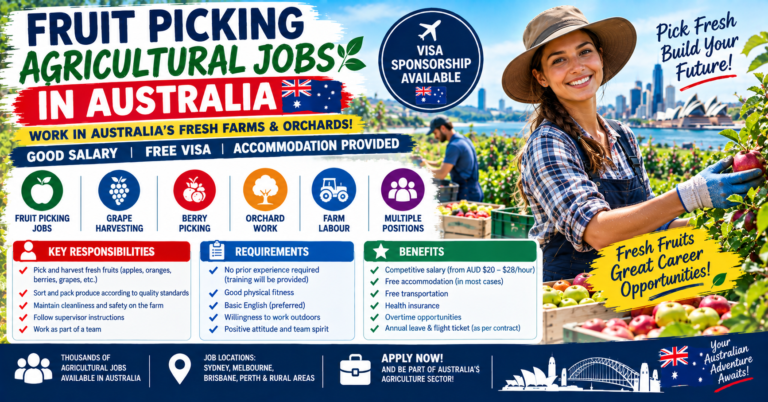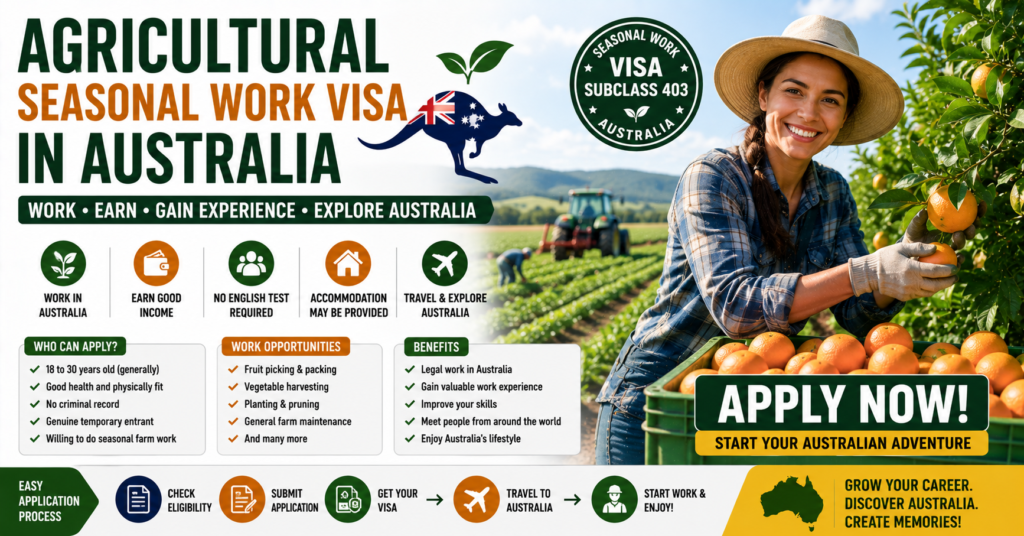
Agricultural Seasonal Work Visa in Australia
Agricultural Seasonal Work Visa in Australia Australia is one of the world’s leading agricultural nations, producing everything from fresh fruits and vegetables to beef, wool, and grains. To support its booming agricultural sector, Australia offers several visa pathways for seasonal workers who want to work on farms, orchards, vineyards, and other agricultural operations. Whether you’re a backpacker, a Pacific Islander, or a skilled agricultural worker, this comprehensive guide covers everything you need to know about the Agricultural Seasonal Work Visa in Australia.
H1: What Is the Agricultural Seasonal Work Visa in Australia?
The Agricultural Seasonal Work Visa in Australia refers to a set of visa programs specifically designed to allow foreign nationals to work temporarily in Australia’s agricultural and farming industries. These visas help address labor shortages experienced during peak harvest seasons when Australian farmers need additional hands.
Australia’s agricultural sector contributes over AUD $60 billion annually to the national economy and employs hundreds of thousands of seasonal workers each year. The demand for seasonal agricultural workers is highest between October and April, particularly during fruit-picking, vegetable harvesting, and grape-picking seasons.
The Australian Government manages seasonal agricultural work through several visa types, including:
- Subclass 417 – Working Holiday Visa
- Subclass 462 – Work and Holiday Visa
- Pacific Australia Labour Mobility (PALM) Scheme
- Subclass 403 – Temporary Work (International Relations) Visa
H1: Types of Visas for Agricultural Work in Australia
H2: 1. Subclass 417 – Working Holiday Visa
The Working Holiday Visa (Subclass 417) is the most popular visa used by young travelers who want to work and travel across Australia. Holders of this visa can legally work in agricultural roles.
H3: Key Features of Subclass 417:
- Available to citizens of 44 eligible countries including the UK, Ireland, Canada, France, Germany, Italy, Japan, South Korea, and more
- Allows holders to stay in Australia for up to 12 months
- Can be extended to a Second Year (Subclass 417) and a Third Year if specified regional work is completed
- Minimum age: 18 years
- Maximum age: 30 years (35 years for some countries)
- Must complete 88 days of specified work in regional Australia to qualify for a second-year visa
- Must complete an additional 88 days of specified work for a third-year visa
H3: Countries Eligible for Subclass 417:
- United Kingdom
- Ireland
- Canada
- France
- Germany
- Italy
- Japan
- South Korea
- Netherlands
- Denmark
- Sweden
- Norway
- Finland
- Belgium
- Cyprus
- Malta
- Estonia
- Taiwan
- Hong Kong
- And many more
H2: 2. Subclass 462 – Work and Holiday Visa
The Work and Holiday Visa (Subclass 462) is similar to the 417 but is available to citizens of different countries, particularly those in Asia, South America, and Eastern Europe.
H3: Key Features of Subclass 462:
- Available to citizens of 28 eligible countries including USA, Argentina, Chile, China, Indonesia, India (limited quota), Thailand, and Vietnam
- Stay duration: Up to 12 months
- Can be extended to a second year after completing 88 days of regional work
- Minimum age: 18 years
- Maximum age: 30 years
- Must have completed at least 2 years of tertiary study
- Must have functional English
H3: Countries Eligible for Subclass 462:
- United States of America
- Argentina
- Bangladesh
- Chile
- China
- Hungary
- Indonesia
- Israel
- Luxembourg
- Malaysia
- Peru
- Poland
- Portugal
- San Marino
- Singapore
- Slovakia
- Slovenia
- Spain
- Thailand
- Turkey
- Uruguay
- Vietnam
- India (limited numbers)
- Ecuador
- Philippines (limited)
- And others
H2: 3. Pacific Australia Labour Mobility (PALM) Scheme
The PALM Scheme is a government-to-government program that allows workers from Pacific Island nations and Timor-Leste to work in Australia’s agriculture and other sectors. This scheme replaced the older Seasonal Worker Programme (SWP) and Pacific Labour Scheme (PLS) in 2022.
H3: Key Features of the PALM Scheme:
- Workers come from Pacific Island countries such as Fiji, Vanuatu, Samoa, Tonga, Papua New Guinea, Solomon Islands, Kiribati, Tuvalu, Nauru, and Timor-Leste
- Workers can stay for up to 9 months (seasonal) or up to 4 years (longer-term)
- Employers must be PALM-approved
- Provides workers with guaranteed minimum hours and wages
- Workers receive support including accommodation, health insurance, and transport
- Focuses on unskilled and semi-skilled work in horticulture, meat processing, and other agriculture
H3: Countries Eligible for PALM Scheme:
- Fiji
- Vanuatu
- Samoa
- Tonga
- Papua New Guinea
- Solomon Islands
- Kiribati
- Tuvalu
- Nauru
- Timor-Leste
- Cook Islands
- Niue
H2: 4. Subclass 403 – Temporary Work (International Relations) Visa
The Subclass 403 Visa is used under the Seasonal Worker Programme stream for workers from eligible countries outside the Pacific.
H3: Key Features of Subclass 403:
- Used specifically under government-approved programs
- Covers both agricultural and non-agricultural sectors
- Duration: Up to 9 months within a 12-month period
- Requires employer and government sponsorship
- Includes mandatory health and character requirements
H1: Eligibility Requirements
H2: General Eligibility Criteria
To be eligible for agricultural seasonal work visas in Australia, applicants generally must meet the following requirements:
H3: Age Requirements:
- Must be between 18 and 30 years of age (some nationalities can apply up to age 35)
- Some programs like PALM Scheme have different age considerations
H3: Health Requirements:
- Must be in good physical health
- May need to undergo a medical examination
- Must not have tuberculosis (TB)
- May need to provide chest X-ray results
H3: Character Requirements:
- Must have a clean criminal record
- Must provide a police clearance certificate
- Must not have any outstanding immigration obligations
H3: Financial Requirements:
- Must demonstrate sufficient funds for your stay (approximately AUD $5,000 recommended)
- Must have a return airfare or sufficient funds to purchase one
- Must have valid health insurance coverage
H3: Passport Requirements:
- Must hold a valid passport from an eligible country
- Passport must be valid for the entire duration of your stay
H3: English Language Requirements:
- Basic to functional English required for most visa types
- PALM Scheme workers may have language support provided
H1: Benefits of the Agricultural Seasonal Work Visa
H2: Financial Benefits
- Competitive wages: Agricultural workers earn a minimum of AUD $23.23 per hour (as per the 2024 minimum wage)
- Tax refunds: Many seasonal workers are entitled to significant tax refunds
- Overtime pay: Additional earnings during peak seasons
- Piece-rate pay: Some farms offer piece-rate which can significantly increase earnings
- Free or subsidized accommodation: Many employers provide housing
H2: Personal and Professional Benefits
- Travel opportunities: Explore Australia while earning money
- Cultural exchange: Experience Australian culture and lifestyle
- Skills development: Gain practical farming and agricultural skills
- Career advancement: Experience can lead to long-term agricultural career opportunities
- Second and third-year visa eligibility: Complete 88 days of specified work to extend your stay
H2: Lifestyle Benefits
- Access to Australia’s world-class natural environments
- Opportunity to visit iconic Australian landmarks
- Make international friendships
- Experience diverse regional Australian communities
- Develop independence and resilience
H1: Types of Agricultural Work Available
H2: Horticulture and Fruit Picking
The most common form of seasonal agricultural work includes:
H3: Fruit Picking Jobs:
- Strawberry picking – Queensland (July–November)
- Apple and pear picking – Victoria and New South Wales (February–May)
- Grape harvesting (vintage) – South Australia, Victoria, New South Wales (February–April)
- Mango picking – Northern Territory and Queensland (September–December)
- Blueberry picking – Various states (October–February)
- Citrus harvesting – South Australia, Queensland (April–October)
- Cherry picking – Victoria, New South Wales, South Australia (November–January)
- Banana farming – Queensland (Year-round)
H2: Vegetable Farming
- Tomato picking and packing
- Lettuce and leafy vegetable harvesting
- Onion harvesting
- Potato farming
- Zucchini and pumpkin harvesting
- Capsicum and chili picking
H2: Livestock and Animal Husbandry
- Sheep mustering and shearing
- Cattle farming and droving
- Dairy farming
- Poultry processing
- Pig farming
H2: Other Agricultural Work
- Cotton chipping
- Tree planting
- Irrigation maintenance
- Packing and processing in regional factories
- Farm machinery operation
- Pruning and vine maintenance
H2: Peak Seasons by State
| State | Main Crops | Peak Season |
|---|---|---|
| Queensland | Strawberries, mangoes, tomatoes | July – December |
| Victoria | Apples, grapes, tomatoes | January – May |
| South Australia | Grapes, citrus, almonds | February – April |
| New South Wales | Cherries, apples, oranges | October – March |
| Western Australia | Grapes, strawberries, melons | November – April |
| Northern Territory | Mangoes, melons | September – December |
| Tasmania | Apples, cherries, strawberries | December – April |
H1: Salary and Wages
H2: Current Agricultural Wage Rates in Australia (2024)
H3: Minimum Wage:
- The Australian national minimum wage as of July 2024 is AUD $23.23 per hour
- Agricultural workers are covered under the Horticulture Award 2020 or the Pastoral Award 2020
H3: Typical Hourly Rates by Job Type:
| Job Type | Hourly Rate (AUD) |
|---|---|
| Fruit Picker | $23.23 – $28.00 |
| Vegetable Farm Worker | $23.23 – $26.00 |
| Pruner/Vine Worker | $24.00 – $30.00 |
| Machine Operator | $28.00 – $40.00 |
| Farm Supervisor | $35.00 – $55.00 |
| Livestock Worker | $25.00 – $35.00 |
| Dairy Worker | $24.00 – $32.00 |
H3: Piece Rate Pay:
Some farms offer piece-rate pay where workers are paid per bin, bucket, or kilogram of produce picked. Experienced workers can earn:
- Up to AUD $1,500 – $2,500 per week during peak grape harvest
- Up to AUD $1,000 – $2,000 per week during apple harvest
- Up to AUD $800 – $1,500 per week during strawberry season
H3: Additional Entitlements:
- Overtime pay (150% of base rate for first 2 hours, 200% thereafter)
- Weekend penalty rates
- Paid sick leave (some conditions apply)
- Superannuation contributions (currently 11%)
H1: How to Apply – Step-by-Step Guide
H2: Step 1: Determine Your Eligible Visa Type
Before applying, identify which visa category suits you:
- Check your citizenship and age against eligible country lists
- Decide between Subclass 417, 462, or PALM Scheme
- Visit the Department of Home Affairs website at www.homeaffairs.gov.au
H2: Step 2: Create an ImmiAccount
- Go to https://immi.homeaffairs.gov.au/
- Click on “Create Account”
- Fill in your personal details
- Verify your email address
- Log in to your ImmiAccount
H2: Step 3: Gather Required Documents
Prepare all necessary documentation (listed in the Documents Section below)
H2: Step 4: Submit Your Visa Application Online
- Log into your ImmiAccount
- Select the appropriate visa subclass
- Complete all sections of the application form
- Upload scanned copies of all required documents
- Pay the visa application fee
H2: Step 5: Wait for Health and Character Checks
- Complete a medical examination if required
- Submit police clearance certificate
- Biometric collection if required
H2: Step 6: Receive Your Visa Decision
- Visa decisions are usually communicated via email
- Check your ImmiAccount for updates
- If approved, your visa will be electronically linked to your passport
H2: Step 7: Plan Your Travel and Arrival
- Book your flights to Australia
- Arrange accommodation in your first destination
- Contact approved employers or recruitment agencies
- Register with Job Active or Harvest Trail services
H2: Step 8: Register with the Harvest Trail
- Visit www.workforceaustralia.gov.au
- Sign up for the Harvest Trail service
- Find seasonal job listings across Australia
- Connect with regional employers
H1: Approved Agencies and Employers
H2: Government-Approved PALM Scheme Approved Employers
The Australian Government maintains a list of PALM Scheme Approved Employers. These include large agricultural operations, labor hire companies, and processing facilities.
H3: Major Approved Recruitment Agencies:
H3: 1. Agstaff Australia
- Location: Level 3, 480 Collins Street, Melbourne, VIC 3000
- Phone: +61 3 9670 5600
- Email: info@agstaff.com.au
- Website: www.agstaff.com.au
- Specialization: Horticulture, viticulture, livestock
H3: 2. Harvest Recruitment
- Location: 123 King Street, Sydney, NSW 2000
- Phone: +61 2 9876 5432
- Email: harvest@harvestrecruitment.com.au
- Website: www.harvestrecruitment.com.au
- Specialization: Fruit picking, vegetable farms, packing sheds
H3: 3. Pinnacle People (Agricultural Division)
- Location: 300 Ann Street, Brisbane, QLD 4000
- Phone: +61 7 3839 0000
- Email: agri@pinnaclepeople.com.au
- Website: www.pinnaclepeople.com.au
- Specialization: Queensland agriculture and horticulture
H3: 4. Labour Solutions Australia (LSA)
- Location: 100 Grenfell Street, Adelaide, SA 5000
- Phone: +61 8 8212 8900
- Email: info@labsol.com.au
- Website: www.labsol.com.au
- Specialization: PALM Scheme, Pacific worker recruitment
H3: 5. Agri Labour Australia
- Location: Level 5, 12 Creek Street, Brisbane, QLD 4000
- Phone: +61 7 3221 7234
- Email: info@agrilabour.com.au
- Website: www.agrilabour.com.au
- Specialization: All types of agricultural and farm work
H3: 6. Skilled Agri
- Location: 45 Market Street, Perth, WA 6000
- Phone: +61 8 9321 4567
- Email: info@skilledagri.com.au
- Website: www.skilledagri.com.au
- Specialization: Western Australian farms and vineyards
H3: 7. Sunraysia Labour Hire
- Location: 78 Langtree Avenue, Mildura, VIC 3500
- Phone: +61 3 5021 1234
- Email: jobs@sunraysialabour.com.au
- Website: www.sunraysialabour.com.au
- Specialization: Murray-Darling region fruits, grapes, citrus
H3: 8. SWiS (Seasonal Workers in the Sunraysia)
- Location: 32 Deakin Avenue, Mildura, VIC 3500
- Phone: +61 3 5022 7890
- Email: info@swisagri.com.au
- Specialization: Citrus, table grapes, dried fruits
H2: Government Employment Services
H3: Workforce Australia (Harvest Trail)
- Website: www.workforceaustralia.gov.au
- Phone: 13 62 68 (National Employment Line)
- Service: Free job matching service connecting seasonal workers with employers across Australia
- Locations: Regional offices across all Australian states and territories
H3: National Harvest Labour Information Service
- Phone: 1800 062 332 (Free call within Australia)
- Hours: Monday to Friday, 8:00 AM – 6:00 PM AEST
- Website: www.jobsearch.gov.au/harvest
- Service: Free service providing information about seasonal harvest jobs, locations, and timing
H2: PALM Scheme Approved Sending Countries Contact Points
H3: Fiji Labour Sending Unit:
- Organization: Fiji Revenue and Customs Service (Labour Division)
- Location: Suva, Fiji
- Phone: +679 331 5577
H3: Vanuatu:
- Organization: Department of Labour, Vanuatu
- Location: Port Vila, Vanuatu
- Phone: +678 25 834
H3: Samoa:
- Organization: Ministry of Commerce, Industry and Labour (MCIL)
- Location: Apia, Samoa
- Phone: +685 20 441
H3: Tonga:
- Organization: Ministry of Internal Affairs
- Location: Nuku’alofa, Tonga
- Phone: +676 23 022
H3: Papua New Guinea:
- Organization: Department of Labour and Industrial Relations
- Location: Port Moresby, PNG
- Phone: +675 321 7533
H2: Australian Department of Home Affairs Offices
H3: Sydney Office:
- Address: Level 14, 10 Spring Street, Sydney, NSW 2000
- Phone: 131 881
- Hours: Monday–Friday, 9:00 AM – 4:00 PM
H3: Melbourne Office:
- Address: Level 3, 2 Lonsdale Street, Melbourne, VIC 3000
- Phone: 131 881
- Hours: Monday–Friday, 9:00 AM – 4:00 PM
H3: Brisbane Office:
- Address: 303 Adelaide Street, Brisbane, QLD 4000
- Phone: 131 881
- Hours: Monday–Friday, 9:00 AM – 4:00 PM
H3: Perth Office:
- Address: Level 9, 111 St Georges Terrace, Perth, WA 6000
- Phone: 131 881
- Hours: Monday–Friday, 9:00 AM – 4:00 PM
H3: Adelaide Office:
- Address: Level 4, 55 Currie Street, Adelaide, SA 5000
- Phone: 131 881
- Hours: Monday–Friday, 9:00 AM – 4:00 PM
H3: Darwin Office:
- Address: 38 Cavenagh Street, Darwin, NT 0800
- Phone: 131 881
- Hours: Monday–Friday, 9:00 AM – 4:00 PM
H3: Hobart Office:
- Address: 188 Collins Street, Hobart, TAS 7000
- Phone: 131 881
- Hours: Monday–Friday, 9:00 AM – 4:00 PM
Important Note: The main Department of Home Affairs immigration enquiry line is 131 881, available Monday to Friday, 9:00 AM to 5:00 PM local time. For online enquiries, visit www.homeaffairs.gov.au
H1: Documents Required
H2: Essential Documents for All Applicants
H3: Identity Documents:
- ✅ Valid passport (with at least 6 months validity beyond intended stay)
- ✅ Birth certificate
- ✅ National identity card (if applicable)
- ✅ Recent passport-sized photographs
H3: Financial Documents:
- ✅ Bank statements (last 3-6 months)
- ✅ Evidence of sufficient funds (minimum AUD $5,000)
- ✅ Return flight ticket or proof of funds to purchase one
- ✅ Travel insurance documentation
H3: Health Documents:
- ✅ Medical examination results (if required)
- ✅ Chest X-ray results (if required)
- ✅ Vaccination records
- ✅ Health insurance policy
H3: Character Documents:
- ✅ Police clearance certificate from your home country
- ✅ Police clearance from any country you lived in for 12+ months (in the last 10 years)
- ✅ Statutory declaration (if applicable)
H3: Educational Documents (for Subclass 462):
- ✅ University degree or diploma transcripts
- ✅ Academic certificates
- ✅ English language proficiency evidence
H3: Work and Employment Documents (for PALM Scheme):
- ✅ Employer nomination form
- ✅ Employment contract
- ✅ Labor agreement documentation
- ✅ Employer PALM approval number
H1: Processing Time and Fees
H2: Visa Processing Times
| Visa Type | Processing Time |
|---|---|
| Subclass 417 (Working Holiday) | 1 day – 4 weeks |
| Subclass 462 (Work and Holiday) | 1 day – 8 weeks |
| PALM Scheme (Subclass 403) | 2 – 8 weeks |
Processing times may vary based on individual circumstances and application completeness
H2: Visa Application Fees (2024)
| Visa Type | Fee (AUD) |
|---|---|
| Subclass 417 – First Year | $635 |
| Subclass 417 – Second Year | $635 |
| Subclass 417 – Third Year | $635 |
| Subclass 462 – First Year | $635 |
| Subclass 462 – Second Year | $635 |
| PALM Scheme (employer-funded) | Varies |
Note: PALM Scheme visa fees are typically covered by the approved employer. Fees are subject to annual review by the Australian Government.
H1: Key Takeaways
H2: 🌟 Most Important Points to Remember
| # | Key Takeaway |
|---|---|
| 1 | Australia offers multiple visa pathways for agricultural seasonal workers including Subclass 417, 462, and the PALM Scheme |
| 2 | Working 88 days in regional agriculture can qualify you for a second and third year visa extension |
| 3 | The minimum agricultural wage in Australia is AUD $23.23 per hour (2024) |
| 4 | The PALM Scheme provides Pacific Island workers with guaranteed hours, accommodation, and support |
| 5 | The peak agricultural season is generally October to April across most Australian states |
| 6 | All visa applications must be submitted online through the Department of Home Affairs ImmiAccount |
| 7 | Queensland and Victoria have the highest demand for agricultural seasonal workers |
| 8 | Free job-matching services are available through the National Harvest Labour Information Service at 1800 062 332 |
| 9 | Workers must maintain valid health insurance throughout their stay in Australia |
| 10 | Piece-rate agricultural work can yield significantly higher earnings than the hourly minimum wage |
H1: Conclusion
Australia’s agricultural sector continues to be one of the most attractive destinations for seasonal workers worldwide. With a strong economy, world-class working conditions, high wages, and the opportunity to explore one of the most beautiful countries on Earth, working in Australian agriculture is a life-changing experience.
Whether you are a young backpacker looking to extend your Working Holiday Visa through completing your 88 days of regional work, a Pacific Islander seeking better economic opportunities through the PALM Scheme, or an experienced agricultural worker wanting to gain international experience — Australia has a visa pathway designed for you.
The key to a successful agricultural work experience in Australia is:
✅ Choosing the right visa for your nationality and circumstances
✅ Applying well in advance of your intended travel date
✅ Registering with approved agencies and the Harvest Trail service
✅ Understanding your workplace rights and minimum wage entitlements
✅ Maintaining valid health insurance and keeping all documents up to date
✅ Saving your payslips and evidence of days worked for visa extension purposes
Australia’s agricultural industry needs you, and the rewards — both financially and personally — are enormous. Take the first step today by visiting the Department of Home Affairs website at www.homeaffairs.gov.au or calling 131 881 to begin your Australian agricultural adventure.
H1: Frequently Asked Questions (FAQs)
H2: General Questions
H3: Q1. What is the 88-day rule for agricultural work in Australia?
A: The 88-day rule refers to the requirement that Working Holiday Visa (Subclass 417 or 462) holders must complete 88 calendar days (about 3 months) of specified regional work to be eligible for a second-year visa extension. This work must be in a regional area of Australia and in an eligible industry such as plant and animal cultivation, fishing, mining, construction, or bushfire recovery.
H3: Q2. Can I work in agriculture without a specific agricultural visa?
A: Yes. Many visitors use the Working Holiday Visa (Subclass 417 or 462) to work in agriculture. These visas allow you to work for any Australian employer. However, if you are from a Pacific Island nation, the PALM Scheme provides a more structured and supported pathway specifically for agricultural work.
H3: Q3. How much money can I earn working in Australian agriculture?
A: On the minimum hourly wage of AUD $23.23, you can expect to earn approximately:
- $900 – $1,000 per week working full-time hours
- $1,500 – $2,500 per week on piece-rate during peak harvest
- Annual earnings potential of $40,000 – $80,000+ depending on your skills, location, and season
H3: Q4. Is accommodation provided for agricultural workers?
A: Accommodation arrangements vary by employer:
- PALM Scheme employers are required to provide accommodation
- Many farms and labor hire companies offer on-farm housing for a deducted weekly fee
- Independent workers must arrange their own accommodation
- Regional areas often have affordable caravan parks and hostels catering to seasonal workers
H3: Q5. Do I need to speak English to work in Australian agriculture?
A: For Working Holiday Visas, functional English is required. For the PALM Scheme, basic English is helpful but language support is often provided by approved employers. In practice, many agricultural workplaces have multilingual teams.