Room Attendant Jobs in Ireland
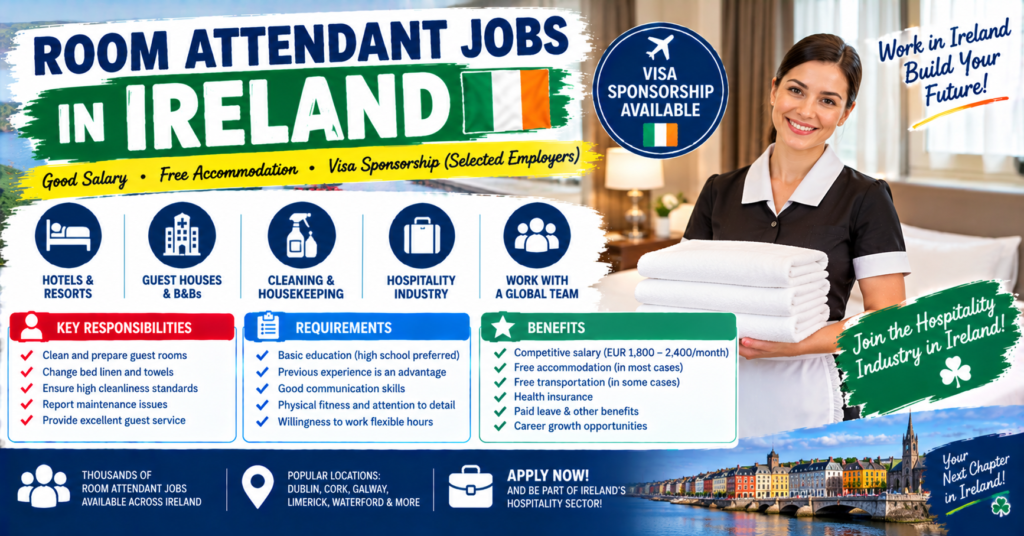
Room Attendant Jobs in Ireland Ireland’s tourism and hospitality industry is booming, and hotels across the country are actively recruiting room attendants (also known as housekeeping attendants or room maids) to keep guest rooms spotless and welcoming. Whether you live in Ireland or are planning to move there for work, this complete guide covers everything you need to know: job duties, salary expectations, requirements, top hiring locations, recruitment agencies, visa information, and a step-by-step application process.
Why Room Attendant Jobs Are in High Demand in Ireland
Ireland welcomes millions of visitors every year, and the hospitality sector is one of the country’s largest employers. After years of staff shortages, hotels in Dublin, Cork, Galway, Killarney, and resort areas are offering competitive pay, flexible shifts, and in some cases staff accommodation to attract housekeeping staff.
Key reasons for demand include:
- Strong tourism growth – city breaks, castles, and the Wild Atlantic Way keep hotels full year-round.
- New hotel openings in Dublin and regional cities.
- High staff turnover in housekeeping, creating constant vacancies.
- Little to no experience required for entry-level roles, making it one of the most accessible jobs in Ireland for newcomers.
What Does a Room Attendant Do?
A room attendant is responsible for cleaning and preparing guest rooms to hotel standards. You’ll usually work within the housekeeping department, reporting to a Housekeeping Supervisor or Executive Housekeeper.
Typical Duties and Responsibilities
- Cleaning, sanitising, and preparing guest bedrooms and bathrooms
- Making beds and changing bed linens and towels
- Replenishing amenities (soaps, tea/coffee supplies, toiletries)
- Vacuuming, dusting, mopping, and polishing surfaces
- Checking and reporting maintenance issues (lights, taps, TVs)
- Following health & safety and hygiene procedures
- Handling lost property according to hotel policy
- Reporting room status to the supervisor (clean, occupied, out of order)
Working Conditions
- Hours: Typically 39 hours per week, often on rotating shifts, including weekends and holidays
- Shifts: Morning shifts are most common (roughly 7:00 AM – 3:30 PM)
- Environment: Physically active work — lots of walking, bending, and lifting
- Benefits: Many hotels provide uniforms, meals on duty, and staff discounts
Requirements to Work as a Room Attendant in Ireland
One of the biggest advantages of this role is that no formal qualifications are required. Most hotels look for:
- Basic conversational English (enough to follow instructions and interact politely with guests)
- Attention to detail and a strong work ethic
- Physical fitness and stamina
- Reliability and punctuality
- Previous cleaning or hotel experience (preferred but not essential — training is provided)
- Legal right to work in Ireland (EU/EEA passport, Irish residence permit, or valid work permit)
Some employers may also request references and, occasionally, Garda (police) vetting.
Room Attendant Salary in Ireland (2025)
Pay varies by location, hotel standard, and experience. Most room attendants are paid the national minimum wage or above.
| Experience Level | Hourly Rate (approx.) | Annual Salary (approx.) |
|---|---|---|
| Entry level / no experience | €13.00 – €14.00 | €25,000 – €27,000 |
| Experienced (2+ years) | €14.00 – €15.50 | €27,000 – €30,000 |
| Dublin 4/5-star hotels | €14.50 – €16.00 | €28,000 – €31,000 |
| Housekeeping Supervisor (progression) | €15.50 – €18.00 | €30,000 – €35,000+ |
Note: Ireland’s national minimum wage increased to €13.50 per hour in 2025. Many hotels also pay a service charge/tips share, provide free meals on shift, and offer overtime rates. Always verify current rates with the employer.
Top Locations for Room Attendant Jobs in Ireland
- Dublin – The largest job market; 4- and 5-star city hotels, airport hotels, and international chains
- Cork & Kinsale (Cork) – City hotels and resort properties such as Fota Island
- Galway – Busy tourist city with strong seasonal demand
- Killarney & Kerry – Major resort towns (e.g., The Europe Hotel, Ballygarry)
- Clare (Shannon/Dromoland) – Castle hotels including Dromoland Castle
- Limerick & Shannon – City hotels and airport-adjacent properties
- Mayo (Westport/Ashford) – Luxury estate hotels, often offering live-in options
- Kildare & Wicklow – Country estate hotels such as The K Club and Powerscourt
Hotels and Employers That Hire Room Attendants
Major hotel groups and employers to check directly include:
- Dalata Hotel Group (Clayton and Maldron hotels nationwide)
- The Shelbourne, The Merrion, The Westbury (Dublin 5-star properties)
- Irish continental and international chains: Hilton, Marriott, Radisson, IHG, Accor
- Ashford Castle (Mayo) and Dromoland Castle (Clare)
- The K Club (Kildare) and Powerscourt Hotel (Wicklow)
- Fota Island Resort (Cork) and The Europe Hotel & Resort (Killarney)
- The Dean Hotels, Trinity Collection, and independent boutique hotels
Most of these employers post vacancies on their own “Careers” pages as well as on job boards.
Can Foreigners Apply? Visas and Work Permits
- EU/EEA/UK citizens can work as room attendants in Ireland without a work permit — you’ll just need a PPS number (Irish tax/social security number) and an Irish bank account.
- Non-EU/EEA applicants generally need an employment permit. Lower-skilled hospitality roles have restrictions under Ireland’s employment permit system, and the eligible occupation lists are updated regularly. Before accepting an offer, always check the current rules on the Department of Enterprise, Trade and Employment (enterprise.gov.ie) website.
- Some employers, particularly rural resort and castle hotels, may assist with accommodation and, occasionally, permits for reliable staff — ask directly during the application process.
Recruitment Agencies for Room Attendant Jobs in Ireland
Registering with a hospitality recruitment agency is one of the fastest ways to find work — agencies are free for job seekers (they’re paid by the hotels).
| Recruitment Agency | Location(s) | Website |
|---|---|---|
| Noelle Recruitment (hospitality specialist) | Dublin | noellerecruitment.com |
| Excel Recruitment (hospitality division) | Dublin / Cork | excelrecruitment.com |
| Connections Recruitment (hospitality & catering) | Dublin | connectionsrecruitment.com |
| FRS Recruitment / FRS Hotel Services | Dublin + nationwide network | frsrecruitment.com |
| CPL Recruitment | Dublin, Cork, Galway, Limerick | cpl.com |
| Collins McNicholas | Galway, Cork, Dublin, Sligo | collinsmcnicholas.ie |
| Hays Ireland | Dublin | hays.ie |
| Brightwater | Dublin | brightwater.ie |
Important note on phone numbers: Agency phone numbers change frequently, so rather than risk outdated contact details, visit each agency’s official website or LinkedIn page for the current phone number and email, or call their head office listed on the “Contact Us” page. You can also walk into Dublin city-centre offices for hospitality agencies during business hours.
Where to find job listings directly:
- Indeed.ie and IrishJobs.ie (largest volume of housekeeping vacancies)
- Jobs.ie and LinkedIn
- EURES (for EU/EEA job seekers)
- Hotel career pages (Dalata, Marriott, Hilton, etc.)
How to Apply for Room Attendant Jobs in Ireland: Step-by-Step
Step 1 – Prepare an Irish-style CV. Keep it to 1–2 pages, highlight any cleaning, hospitality, or customer service experience, and include references.
Step 2 – Gather your documents. Passport or ID, proof of right to work, references/contact details, and (if you already live in Ireland) your PPS number.
Step 3 – Apply widely. Submit applications directly on hotel career pages, upload your CV to Indeed and IrishJobs, and register with 2–3 agencies from the table above.
Step 4 – Contact agencies. Call or email the hospitality consultants, clearly stating the role you want (room attendant/housekeeping), your location, availability, and right to work.
Step 5 – Attend the interview. Interviews are usually short and informal. Many hotels also offer a paid trial shift to see you work.
Step 6 – Complete onboarding. Once hired, you’ll sign a contract, get set up for payroll, and receive training, a uniform, and your rota.
Documents You May Need
- Valid passport or national ID
- Proof of right to work (visa/permit/residence card if applicable)
- PPS number (apply via any Intreo Centre if you don’t have one)
- Irish bank account details for wages
- References from previous employers
Tips to Get Hired Faster
- Apply before the peak season (March–May) when hotels build their summer teams.
- Mention weekend and shift flexibility — this makes you far more attractive to employers.
- Highlight attention to detail and any housekeeping experience, even informal (e.g., home cleaning, healthcare cleaning, Airbnb turnover work).
- Be open to live-in roles at castle and resort hotels, which include staff accommodation and can save significant rent.
- Follow up with agencies by phone — hospitality consultants fill roles quickly.
Key Takeaways
- Room attendant jobs in Ireland are widely available and require no formal qualifications.
- Typical pay is €13.00–€16.00 per hour (€25,000–€31,000 annually), with Dublin and 5-star hotels paying the highest rates.
- Dublin, Cork, Galway, Killarney, and Shannon are the strongest job markets.
- EU/EEA citizens can apply freely; non-EU applicants must check current employment permit rules before applying.
- Specialist hospitality agencies such as Noelle Recruitment, Excel Recruitment, Connections, and FRS Recruitment can place you quickly — verify current phone numbers on their official websites.
- A simple CV, right-to-work documents, and a PPS number are all you need to get started.
Conclusion
Room attendant jobs in Ireland are one of the most accessible and reliable entry points into the country’s thriving hospitality sector. With no formal qualifications needed, solid hourly pay starting around €13.50, opportunities in every county, and a clear path toward supervisory and management roles, it’s an excellent option for locals and newcomers alike. The fastest route to getting hired is to combine direct applications to hotel career pages with registration at specialist hospitality recruitment agencies in Dublin, Cork, and Galway. Prepare a clean CV, confirm your right to work, apply before peak season, and you could be starting your first shift within weeks.
Frequently Asked Questions (FAQs)
1. Do I need experience to become a room attendant in Ireland?
No. Most hotels provide full training. Any cleaning, hospitality, or customer service experience is a bonus but not required.
2. How much do room attendants earn in Ireland?
Between €13.00 and €16.00 per hour depending on location and hotel standard, which works out to roughly €25,000–€31,000 per year full-time.
3. Can international applicants get room attendant jobs in Ireland?
Yes. EU/EEA citizens can work without a permit. Non-EU/EEA applicants need a valid work authorization, and eligibility for hospitality roles under Ireland’s employment permit system changes, so confirm the current rules with the Department of Enterprise, Trade and Employment before applying.
4. Do hotels provide accommodation for staff?
Some do — especially castle hotels, resorts, and rural properties in Kerry, Clare, Mayo, and Wicklow. Live-in roles usually deduct a small amount from wages for accommodation and meals.
5. What are the working hours?
Typically 39 hours per week on a rota, with morning shifts most common. Weekend and holiday work is standard in hotels.
6. Is English fluency required?
You need basic conversational English to follow instructions, understand safety procedures, and greet guests politely. Fluency is not required.
7. What is the career progression?
Room attendants can advance to Senior Room Attendant → Housekeeping Supervisor → Assistant Executive Housekeeper → Executive Housekeeper → Rooms Division Manager.
8. Is a trial shift normal?
Yes. Many Irish hotels offer a short paid trial shift before confirming employment — it’s a good sign, not a red flag.