Butcher Jobs in Canada
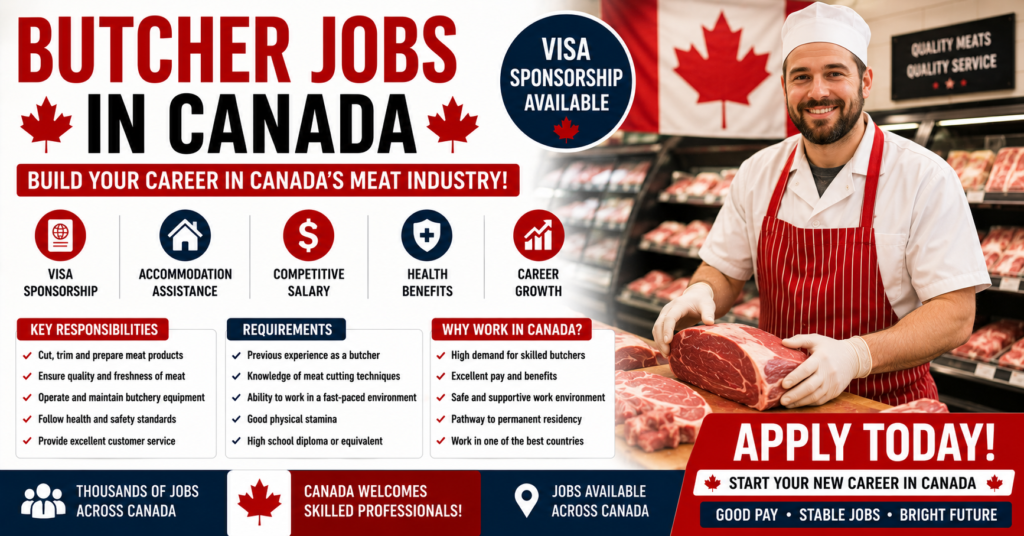
Butcher Jobs in Canada Canada’s meat industry continues to face labour shortages, making butcher jobs one of the most accessible pathways for both local workers and international applicants seeking employment — and even permanent residency. This guide covers everything you need to know: job duties, salaries, requirements, visa options, how to apply, and where to find legitimate recruiters.
Why Butcher Jobs Are in High Demand in Canada
9 Canada’s food processing industry is experiencing significant growth, creating high demand for skilled butchers across the country. With meat production being a major sector in provinces like Alberta, Manitoba, and Ontario, employers are actively recruiting international talent, and many roles provide visa sponsorship. Key reasons for the demand include:
- 9 Labour shortages in both rural and urban areas, a growing food export market (especially beef and pork), and a retiring workforce creating a need for new skilled workers
- 9 Expansion of large meat processing plants such as Cargill, Maple Leaf Foods, and Olymel
Notably, 4IRCC announced that Canada’s Express Entry system would begin targeting occupations in healthcare, technology, trades, transport and agriculture — including butcher under National Occupational Classification 63201 — giving foreign nationals a new opportunity to obtain permanent residence.
Job Duties of a Butcher in Canada
Typical responsibilities include:
- 3 Cleaning meats to prepare for processing or cutting; cutting carcasses, sides and quarters; preparing special cuts of meat ordered by customers; cutting, trimming and preparing standard cuts of meat; and wrapping and packaging prepared meats
- 7 Cutting and deboning meat, trimming processed meat, removing bones, cartilages and inedible parts from meat cuts, working on a line, utilizing hand tools and equipment, and cleaning work areas
- In retail settings, 22providing suggestions to customers on different cuts, cutting techniques and serving sizes
Salary: How Much Do Butchers Earn in Canada?
Estimates vary by source, location, and experience:
| Source | Average Pay |
|---|---|
| Indeed | 11$21.82 per hour |
| ERI / SalaryExpert | 17$41,951/year or about $20.17/hour |
| Glassdoor | 10$39,173 per year or $19 per hour |
| Talent.com | 13$58,500/year; entry-level from $46,800, experienced up to $65,520 |
- 17 An entry-level butcher with 1–3 years of experience earns around $35,027, while a senior butcher with 8+ years earns an average of $46,080
- Some LMIA-approved postings pay significantly more — for example, 3Venerica Meats Inc. in Toronto, ON advertised a permanent full-time wholesale butcher position at $34.07 an hour with extended health care, requiring no degree, certificate or diploma
- Management roles pay even better: 24a full-time Meat Department/Butcher Shop Manager position in Alberta offered annual compensation of $60,000–$80,000
Requirements and Qualifications
- 5 Completion of secondary school may be required; for industrial meat cutters, completion of a program in industrial meat cutting or experience as an industrial butcher is required, and on-the-job training is provided for industrial butchers, meat cutters and poultry preparers
- 9 Employers often require previous experience in meat cutting, knowledge of hygiene standards, and the ability to use equipment like knives and saws; formal training is an advantage but not always mandatory
- 21 Adherence to Hazard Analysis and Critical Control Points (HACCP), Canadian Food Inspection Agency (CFIA) and food safety standards
- 1 Strong physical stamina, as the role requires standing for long periods and lifting heavy items
- Some entry-level roles are flexible: 1certain employers accept just 1–7 months of experience as a butcher or meat cutter and are willing to train motivated individuals
Visa Sponsorship and Immigration Pathways
- Temporary Foreign Worker Program (TFWP): 9Employers apply for an LMIA (Labour Market Impact Assessment) to hire foreign butchers
- Express Entry (category-based draws): 4Candidates need at least six months of continuous work experience in Canada or abroad within the past three years in an eligible occupation
- Provincial Nominee Programs (PNPs): 9Some Canadian employers sponsor visas for skilled butchers under programs like the TFWP or PNPs, where there is demand for meat processing workers
- Agri-Food Pilot: 7The Agri-Food Immigration Pilot program aims to address labour shortages in agricultural industries
Important: 2If you are not legally authorized to work in Canada, you can’t apply for every job on Job Bank, and most Canadian employers will not hire you without a valid visa or work permit.
Where the Jobs Are (Top Locations)
- 4 Ontario and Quebec together accounted for roughly 68% of butcher postings in one Job Bank snapshot, with Quebec employers seeking 184 butchers and Ontario 101
- 19 Open positions are found across cities including Toronto, Mississauga, Hamilton, Surrey (BC), Winnipeg, Brampton, Etobicoke, Brooks (AB), Calgary and Burnaby
How to Apply
- Prepare a Canadian-style resume highlighting meat-cutting experience, food safety knowledge, and physical capability.
- Search official/trusted platforms:
- Job Bank (jobbank.gc.ca) — the Government of Canada’s official job site; 2it recently listed 59 slaughterhouse butcher jobs under NOC 94141 (Industrial butchers and meat cutters, poultry preparers and related workers)
- Indeed.ca — 24currently lists over 660 butcher jobs
- Glassdoor.ca and Workopolis for additional listings
- Filter for LMIA/visa-sponsorship postings if applying from abroad.
- Apply directly to major employers: 20top companies hiring include Freson Market Ltd/Freson Bros., Longo’s, JBS Food Canada ULC, Cargill, and others.
- Attend interviews (often online for overseas candidates), receive your job offer, and let the employer process the LMIA before applying for your work permit.
- 9 Start by researching job offers, preparing a solid resume, and applying through trusted Canadian platforms.
Recruitment Agencies: Names and Locations
⚠️ Caution first: Legitimate recruiters generally do not charge workers for jobs — 7reputable relocation programs state that no fees are paid by workers for employment. Always verify any agency with the provincial licensing registry before paying anyone.
Examples of recruitment channels connected to butcher hiring:
- SkilledWorker.com (sister company of Immigration.ca) — Montreal, Quebec, Canada. 4It helps employers hire foreign workers through a comprehensive recruitment package to identify and hire individuals from abroad.
- MV Group — an international recruiting firm based in Ukraine that has advertised butcher placements; 7it recruited butchers for a Canadian meat processing plant in Saskatchewan, requiring a minimum of 12 months of verified butcher experience and job-ready English, with arranged housing and no employment fees.
- Direct employer recruitment — large processors like Cargill (High River, AB), JBS Food Canada (Brooks, AB), Maple Leaf Foods (Ontario/Manitoba) and Olymel (Quebec) hire directly through their career pages, which is often safer than third-party agencies.
Key Takeaways
- ✅ Butchers are in demand across Canada, especially in Alberta, Ontario, Quebec, and Manitoba.
- ✅ Average pay is roughly $20–$22/hour, with some LMIA postings paying $34+/hour and management roles reaching $80,000/year.
- ✅ No university degree is required — many jobs need only secondary school and hands-on experience or on-the-job training.
- ✅ Multiple immigration routes exist: TFWP (LMIA), Express Entry category-based draws (NOC 63201), PNPs, and the Agri-Food Pilot.
- ✅ Apply through official channels (Job Bank, Indeed, employer websites) and never pay recruitment fees to unverified agents.
Conclusion
9 Canada’s meat processing industry offers strong career opportunities for skilled butchers worldwide, with competitive salaries, visa sponsorship options, and the potential for permanent residency. Whether you’re an experienced industrial butcher or a motivated beginner willing to train, the combination of labour shortages, employer sponsorship, and dedicated immigration pathways makes 2026 an excellent time to pursue a butcher career in Canada. Start with the official Job Bank, target LMIA-approved employers, and verify every recruiter before committing.
FAQs
1. Can foreigners get butcher jobs in Canada? Yes. 9Some Canadian employers sponsor visas for skilled butchers, especially under the Temporary Foreign Worker Program (TFWP) or Provincial Nominee Programs (PNPs) where there is demand for meat processing workers.
2. What is the average salary for a butcher in Canada?11 The average is about $21.82 per hour according to Indeed, while 10 typical annual pay ranges between $33,227 and $46,184.
3. Do I need formal education? Not always. 9Formal training is an advantage but not always mandatory, and 5on-the-job training is provided for industrial butchers, meat cutters and poultry preparers.
4. Which NOC codes apply to butcher jobs? Retail butchers fall under 4NOC 63201, while industrial roles fall under 2NOC 94141 (Industrial butchers and meat cutters, poultry preparers and related workers).
5. Can a butcher job lead to permanent residency? Yes — 4Express Entry now targets butchers, requiring at least six months of continuous work experience within the past three years.
6. How much experience do employers require? It varies — 1some accept 1–7 months and will train motivated individuals, while 19industrial roles may require completion of a meat cutting program or 1–2 years’ experience.