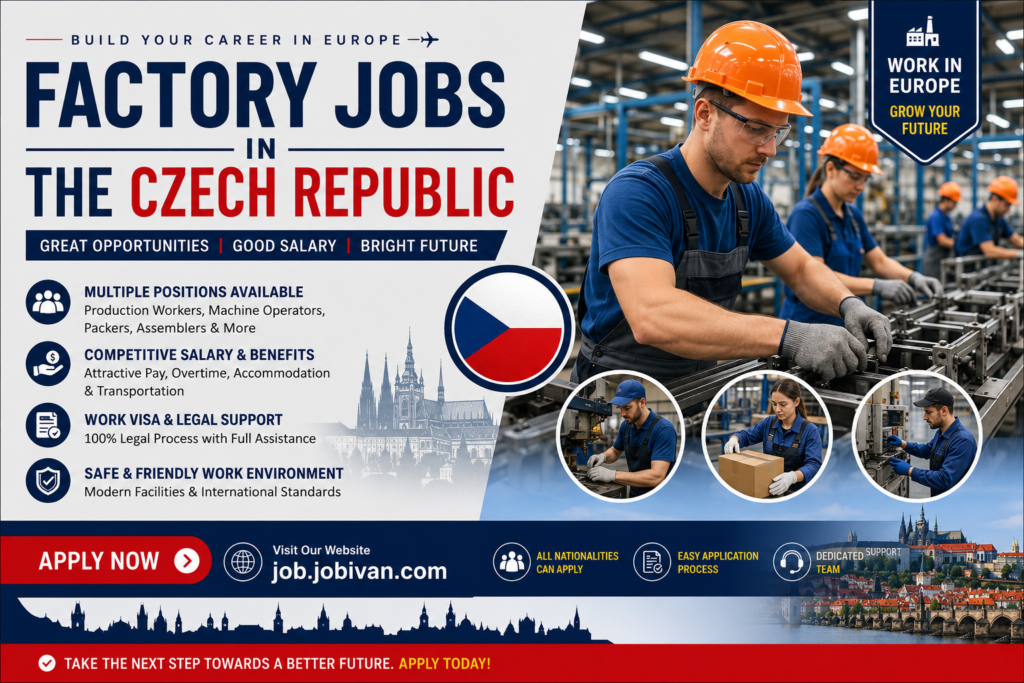
Factory Jobs in the Czech Republic
Factory Jobs in the Czech Republic The Czech Republic has one of the most highly developed, industrialized economies in Europe. Because of this, the manufacturing sector is a massive employer, and there is a high, constant demand for factory workers, operators, and warehouse staff.
Here is a comprehensive overview of what you need to know about factory jobs in the Czech Republic in 2026:
Most Popular Industries
The country is a central European manufacturing hub. The primary sectors hiring factory workers include:
- Automotive: The largest sector. Major plants include Škoda Auto (Mladá Boleslav, Kvasiny), Hyundai (Nošovice), and Toyota (Kolín), plus hundreds of parts suppliers (Bosch, Continental, Valeo).
- Electronics & Technology: Companies like Foxconn (Pardubice, Kutná Hora) and Panasonic (Plzeň) frequently hire assembly line workers.
- Machinery & Metallurgy: Heavy industry, especially in the Moravian-Silesian region (Ostrava).
- Logistics & E-commerce: While not traditional “factories,” massive warehouses for companies like Amazon (Dobrovíz, Kojetín) require similar skill sets.
Requirements and Language
- Skills: For basic assembly or packaging jobs, no prior experience is required, and full on-the-job training is provided. Specialized roles (welders, mechanics, CNC programmers) require vocational certificates.
- Language: For entry-level factory work, fluent Czech is rarely required. Factories are highly multinational; English, Ukrainian, Russian, and Polish are commonly spoken on the factory floor. However, basic Czech is highly recommended for daily life and long-term integration.
Visas and Work Permits
How you can legally work in the Czech Republic depends heavily on your nationality:
- EU/EEA & Swiss Citizens: Enjoy free movement of labor and can work in the Czech Republic without any work permits.
- Non-EU Citizens: Need a work visa, typically the Employee Card (Zaměstnanecká karta), which serves as both a residence and work permit.
- Government Programs: To speed up hiring, the Czech government uses the Qualified Employee Program for certain non-EU countries. Note: For 2026, foreign workers brought in under this program must be offered a minimum salary of 27,328 CZK per month (which is 1.22x the minimum wage).
Common Job Profiles
- Production/Assembly Operator — Manual assembly, machine tending, quality checks on automotive or electronics lines.
- Machine Operator — Operating presses, CNC basics, or automated lines (training often given).
- Warehouse/Logistics Worker — Picking, packing, forklift, material supply to lines.
- Other — Press operator, food production, quality inspector, painter/body repair (at car plants).
Typical conditions:
- 2- or 3-shift system (mornings/afternoons/nights; some plants avoid weekends on certain lines).
- ~7.5–8 hours/day, average 37.5 hours/week.
- Physical work; standing, repetitive tasks, moderate lifting.
- Contracts: Often start with 6-month fixed-term (direct hires) or minimum 2-year via agencies.
Standard Benefits (especially at larger firms):
- Subsidized or provided accommodation + transport (very common for foreigners).
- Subsidized canteen/meals, work clothing/laundry.
- 5–6 weeks vacation, 13th salary or annual bonuses, pension contribution (e.g. 1,700 CZK/month at Škoda).
- Wellness/sports accounts (Z-account or Flexipass), Multisport card, company doctor.
- Training, internal advancement (to team leader, technician), full social/health insurance.
Requirements:
- Age 18+, good physical condition, reliability, manual dexterity.
- Prior factory/assembly/warehouse experience preferred but not always required.
- Basic English often sufficient (especially international teams); Czech helps for promotion.
- For non-EU: Clean criminal record, medical exam, valid passport.
Major Companies Actively Hiring
- Toyota Motor Manufacturing Czech (TMMCZ) – Kolín
Production operators, team leaders, maintenance. Clean, modern, automated plant with Japanese-Czech culture (Toyota Way: safety, continuous improvement, teamwork). Strong emphasis on training, no experience needed for many roles. Excellent benefits: Z-account (recreation, family, study, wellness), Multisport, education support, canteen, bonuses. Open to foreigners; English used. Apply directly at toyota.jobs.cz (vacancies section). Highly recommended for long-term stability and culture. - Škoda Auto (Volkswagen Group) – Mladá Boleslav (main), Kvasiny, Vrchlabí
Assembly workers, painters, body repair technicians, mechatronics technicians, production operators. Modern facilities with major expansion ongoing. Benefits: 5 weeks vacation, subsidized meals, pension contribution, bonuses (including 13th salary), affordable company car rental option, accommodation (~1,800 CZK/month in some plants), bus transport. 3-shift system (7.5 hrs + break). First contract often 6 months fixed + 3-month probation. Apply at skoda-career.com/blue-collar-workers or email nabor@skoda-auto.cz. Large-scale hiring for blue-collar roles.3 - Valeo – Humpolec, Rakovník, Podbořany, Žebrák (Western Bohemia)
Machine operators (assembly of car air-conditioning components, control panels, testing) and logistics/warehouse operators. Requirements: basic education + manual dexterity. Strong benefits package: up to 6 weeks vacation, open-ended contracts after probation, regular raises, monthly + 6-month bonuses, subsidized canteen/transport, pension contribution, wellness allowance (Flexipass), company doctor, laundry service. Shuttle buses available. Apply via plant-specific links on valeo.com/en/career-manual-workers/. Good work-life balance and job security.4 - Foxconn – Pardubice
Electronics assembly, testing, packaging, warehouse roles. Large employer with ongoing needs (including seasonal peaks). Suitable for manual/production work. Often recruits internationally. - Other Significant Employers:
- Hyundai Motor Manufacturing Czech – Nošovice (Moravia): Automotive production and suppliers.
- Automotive suppliers: Magna, Bosch, Continental, Benteler, ZF.
- Tires: Nexen (Žatec).
- Electronics/warehousing: Flex (Pardubice area), Amazon fulfillment centers.
- Many smaller plants in Plzeň, Tachov, Cheb, Kolín, and Brno regions.
Glassdoor and jobs.cz currently show 650–1,100+ manufacturing listings.5
Best Recruitment Agencies for Foreigners (Especially Non-EU)
These handle visa sponsorship (Employee Card), accommodation, transport, and deployment (often 4–5 weeks):
- Taj HR Services (tajhrservices.com) — 40+ employers including the majors above. Full support for non-EU workers. No experience always required; focus on physical fitness and reliability. Strong reviews for automotive/electronics.1
- WorkInCzech.com — Specific production operator packages. Base 21,000–24,768 CZK net, employer-provided accommodation (site-dependent), minimum 2-year contracts, 2–3 shifts. Good English required. They match based on your CV and preferences.2
- Euro-jobs.cz — Many openings in Western Bohemia (Cheb, Tachov, Plzeň areas) for machine setters, operators, production workers.
- Others: Adecco Czechia, ASPO, Czech Recruitment Agency.
Official channels: EURES (eures.europa.eu), Úřad práce (uradprace.cz – Central Vacancy Database), jobs.cz.
Quick Application Tips
- Prepare Europass CV, passport copy, photos, any certificates (forklift, experience letters).
- Specify preferred location, shifts, and visa status.
- Many roles start with interview (video or in-person) + medical check.
- Non-EU warning: Only use reputable agencies/employers. Never pay large upfront fees. Job offer usually required before Employee Card application (process takes 1–3+ months).
The market remains very favorable for motivated workers. Living costs are manageable outside Prague (especially with subsidized housing), allowing good savings potential.
Provide more details (your nationality, experience level, preferred region, specific role like automotive or electronics, or whether you need visa help) and I can give more targeted links, browse current exact vacancies, or outline the exact visa steps. Would you like me to pull details for a specific company or agency next?
Apply Now || Apply Now || Apply Now ||
The Salary Reality: Gross vs. Net Pay
In the Czech Republic, salaries are always advertised in Gross (Hrubá mzda). You must calculate your Net pay (Čistá mzda) to know what actually hits your bank account. Deductions for health insurance, social security, and income tax typically take about 20% to 22% of your paycheck.
A Realistic Monthly Scenario (2026): Let’s look at a standard production operator working 3 shifts (including some nights).
- Base Gross Salary: 28,000 CZK
- Shift Bonuses (Nights/Weekends/Overtime): + 6,000 CZK
- Total Gross Salary: 34,000 CZK
- Actual Net Pay (Take-Home): Approx. 27,500 CZK (€1,085)
The Cost of Living (Where does that money go?):
- Housing is the biggest hurdle. If you rent a private 1-bedroom apartment in an industrial town (like Plzeň or Mladá Boleslav), rent and utilities will cost you 15,000 – 18,000 CZK a month. This will eat up more than half your salary.
- Food & Groceries: Expect to spend around 6,000 – 8,000 CZK per month for a single person.
- Phone/Transport: Approx. 1,000 – 1,500 CZK.
The Savings Verdict: If you rent your own private apartment, an entry-level factory worker will live paycheck to paycheck with very little ability to save. However, if you use agency-provided dormitories (which cost roughly 3,000 – 6,000 CZK/month, or are sometimes free) or share a flat with roommates, a frugal worker can save 10,000 to 15,000 CZK (€400 – €600) per month.
The Job Market Reality
The Czech Republic has one of the lowest unemployment rates in the EU. Young Czechs are largely avoiding manual labor, meaning the industrial economy is heavily reliant on foreign workers.
Here is what you need to know about the current environment:
The “Two-Tier” Employment System The biggest reality check for foreign workers is the divide between agency workers and direct employees.
- Agency Workers (Agenturní zaměstnanci): You are hired by a temp agency and leased to the factory. While Czech law dictates you must receive the same base pay for the same work as direct employees, agencies often absorb housing costs out of your bonuses. Agency workers are also the first to be let go if the factory reduces production.
- Direct / Core Employees (Kmenoví zaměstnanci): Hired directly by the factory (e.g., signing a contract directly with Škoda or Panasonic). You get ironclad protections under the Czech Labor Code, union representation, and massive perks like 13th/14th-month salaries and yearly profit-sharing bonuses.
- Tip: Many start in an agency and work hard for 6–12 months to be “absorbed” as a core employee by the factory.
The Physical Toll of Shifts Czech factories run on intense shift schedules. The most common is the rotating 3-shift system: one week of morning shifts (6:00-14:00), one week of afternoons (14:00-22:00), and one week of nights (22:00-6:00). Alternatively, many use a “short week / long week” 12-hour shift system. While you get days off, the constant disruption to your sleep cycle is physically and mentally exhausting.
The Impact of Automation (2026 Trend) Factories are highly focused on automation. Basic, repetitive assembly tasks are slowly being handed over to robotics. Because of this, the highest job security and salary growth belong to machine operators, CNC setters, automation technicians, and quality control personnel—not just basic manual assemblers.
Regional Reality (Where to go)
Your experience will differ wildly depending on where the factory is located:
- Prague & Central Bohemia: Companies here pay the highest salaries, but the cost of living in and around Prague is very expensive. Unless the company provides subsidized housing, the higher salary is entirely eaten up by rent.
- Plzeň (Pilsen) & Karlovy Vary Regions: Very close to the German border with a massive concentration of automotive and electronics factories. This region has a huge, established community of foreign workers (Ukrainian, Romanian, Bulgarian, Asian). It is highly geared toward factory life.
- Moravia-Silesia (Ostrava): The traditional heavy-industry heartland. Salaries are generally lower here than in Bohemia, but the cost of rent and daily living is significantly cheaper.
Key Takeaways
- High Demand, Low Barriers: The Czech Republic remains an industrial powerhouse in 2026. If you are physically fit and willing to work shifts, you can find a job almost immediately, even with zero experience or Czech language skills.
- Housing is the Dealbreaker: An entry-level factory salary (averaging 27,500 CZK net/month) is not enough to comfortably rent a private apartment and save money. To build savings, you must utilize agency-provided dormitories or share flats with roommates.
- Agency vs. Direct Employment: Recruitment agencies are the easiest way in (especially for non-EU citizens needing visas and housing), but your ultimate goal should always be to get a direct contract with the factory for better job security, union protection, and annual bonuses.
- Upskilling Pays Off: Basic assembly workers are easily replaced, but there is a massive shortage of skilled trades. Getting a forklift license, welding certificate, or learning CNC operation can boost your salary by 40% to 60%.
- Shift Work is Demanding: Be prepared for rotating 3-shift systems (morning, afternoon, night) or 12-hour shifts. The legal labor protections are strong, but the physical toll is real.
Conclusion
Taking a factory job in the Czech Republic is an excellent stepping stone, but rarely a final destination.
If you are an EU citizen looking for a quick job, or a non-EU citizen looking for a legal pathway into the European labor market, the Czech Republic offers one of the safest, most reliable, and heavily regulated environments to do so. The country boasts excellent public transport, very low crime rates, and robust healthcare.
However, it is not a place to get rich quick. To succeed here, you need a strategy: use your first year to live frugally in subsidized housing, show up to every shift to collect attendance bonuses, learn basic Czech, and actively look for opportunities to transition from an agency worker to a direct “core” employee.
Frequently Asked Questions (FAQs)
1. Do I need to speak Czech to get a factory job? No. For basic roles (assembly, packing), factories are highly international. Floor managers often speak English, and there are large communities of Ukrainian, Russian, Polish, and Vietnamese speakers. However, if you want to become a shift leader, get a direct contract, or deal with local bureaucracy, learning basic Czech is essential.
2. As a non-EU citizen, how long does it take to get a work visa? If you apply for an Employee Card (Zaměstnanecká karta), the process typically takes 3 to 5 months from the moment you submit your application at the embassy. If a large factory hires you through the government’s “Qualified Employee Program,” the process can be expedited.
3. Can I bring my family with me?
- EU Citizens: Yes, immediately.
- Non-EU Citizens: Usually, no—at least not right away. Under standard Czech immigration law, you generally must reside in the country for at least 15 months on an Employee Card before you can apply for family reunification visas for your spouse and children.
4. Are there age limits for factory workers? By law, you must be at least 18 years old. There is no legal upper age limit, but factory work is heavily dependent on your physical health. You will be required to pass a mandatory occupational medical exam by a Czech doctor before you can sign your contract. If your eyesight, back, or heart health is poor, you will not be cleared for shift work.
5. How much money can I realistically save each month?
- If you live in a free or cheap agency dormitory, eat in the factory canteen, and live frugally: You can save €400 to €600 (10,000 – 15,000 CZK) per month.
- If you rent a private 1-bedroom apartment and live a standard lifestyle: You will likely save €0 to €150 per month on a basic operator salary.