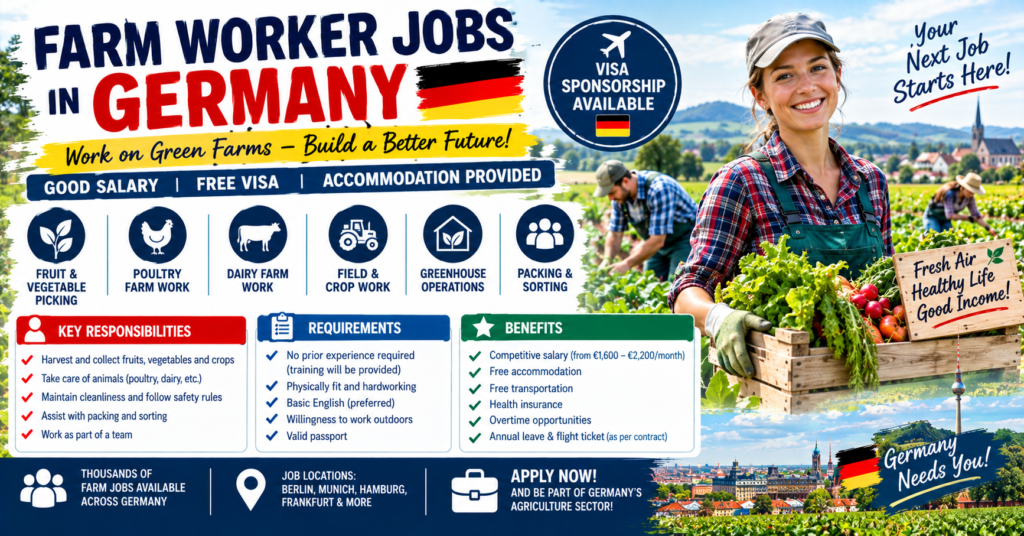
Farm Worker Jobs in Germany
Farm Worker Jobs in Germany Germany, one of Europe’s largest agricultural economies, offers thousands of farm worker jobs every year to both local and international workers. With its well-organized farming sector, competitive wages, and excellent working conditions, Germany has become a top destination for seasonal and permanent farm workers from around the world.
Whether you’re looking for fruit picking, livestock management, crop harvesting, or greenhouse work, this comprehensive guide covers everything you need to know about farm worker jobs in Germany — including how to apply, agency contacts, salaries, visa requirements, and more.
Why Choose Farm Worker Jobs in Germany?
Germany’s agricultural sector contributes significantly to the country’s economy. The country produces wheat, barley, sugar beets, potatoes, grapes, apples, and various vegetables on a massive scale. Due to labor shortages, especially during peak harvest seasons, Germany actively recruits foreign workers.
Key Reasons to Work on German Farms:
- Competitive Wages: Germany offers the minimum wage of €12.41 per hour (2024), with many farms paying more
- Legal Protections: Strong labor laws protect workers’ rights
- Seasonal Opportunities: Work permits available for seasonal employment (up to 90 days)
- Pathway to Residency: Some positions can lead to long-term work permits
- Free or Subsidized Accommodation: Many farms provide housing and meals
- Cultural Experience: Opportunity to live and experience European culture
- No Degree Required: Most positions don’t require formal education
Types of Farm Worker Jobs Available in Germany
Fruit and Vegetable Picking
This is the most common type of farm work in Germany. Workers are needed to harvest:
- Strawberries
- Asparagus (highly in demand)
- Apples and pears
- Cherries and berries
- Grapes (vineyard work)
- Cucumbers, tomatoes, and lettuce
Peak Season: April to October
Livestock and Dairy Farming
Germany has a significant dairy and livestock industry. Jobs include:
- Milking cows
- Feeding and caring for animals
- Cleaning barns and stalls
- Monitoring animal health
- Operating milking machines
Season: Year-round
Crop Planting and Field Work
- Plowing and preparing fields
- Planting seeds and seedlings
- Irrigating crops
- Applying fertilizers
- Weeding and pest control
Season: March to November
Greenhouse and Nursery Work
- Planting flowers and ornamental plants
- Watering and maintaining greenhouse environments
- Packaging plants for sale
- Operating greenhouse equipment
Season: Year-round (indoor work)
Vineyard Work
Germany is famous for its wine production, especially along the Rhine and Mosel valleys. Vineyard jobs include:
- Pruning vines
- Grape harvesting (Weinlese)
- Sorting and processing grapes
- General vineyard maintenance
Peak Season: September to November
Agricultural Machine Operation
- Operating tractors and harvesters
- Maintaining farm equipment
- Transporting crops
- Operating irrigation systems
Season: Year-round
Salary and Wages for Farm Workers in Germany
| Position | Hourly Wage (€) | Monthly Estimate (€) |
|---|---|---|
| Fruit/Vegetable Picker | €12.41 – €14.00 | €1,800 – €2,400 |
| Livestock Worker | €12.50 – €15.00 | €2,000 – €2,600 |
| Greenhouse Worker | €12.41 – €14.50 | €1,900 – €2,500 |
| Tractor/Machine Operator | €13.00 – €16.00 | €2,200 – €2,800 |
| Farm Supervisor | €15.00 – €20.00 | €2,600 – €3,500 |
| Vineyard Worker | €12.41 – €15.00 | €1,800 – €2,500 |
| Dairy Farm Worker | €12.50 – €15.50 | €2,000 – €2,700 |
Note: Wages may vary based on region, farm size, experience, and the type of work. Overtime is usually paid at a higher rate.
Eligibility and Requirements
Basic Requirements:
- Age: 18 years or older (some farms accept 16+ with parental consent)
- Physical Fitness: Farm work is physically demanding
- No Criminal Record: Clean background check required
- Valid Passport: Must have at least 6 months validity
- Work Permit/Visa: Required for non-EU citizens
- Health Certificate: Medical fitness certificate may be required
Preferred Qualifications:
- Previous farming or agricultural experience
- Basic knowledge of German language (helpful but not always required)
- Ability to work in various weather conditions
- Teamwork and reliability
- Willingness to work long hours during peak seasons
Language Requirements:
- EU Citizens: No language requirement for most positions
- Non-EU Citizens: Basic German (A1-A2 level) is preferred but not mandatory for all positions
- Many farms with international workers use English as a working language
Visa and Work Permit Information
For EU/EEA Citizens:
Citizens of EU/EEA countries (including Switzerland) do not need a visa or work permit. They can freely live and work in Germany.
For Non-EU Citizens:
Non-EU citizens require a work visa. The main options are:
1. Seasonal Work Visa (Saisonarbeit)
- Duration: Up to 90 days within a 180-day period
- No formal qualifications required
- Employer must be registered with the Federal Employment Agency (Bundesagentur für Arbeit)
- Processing time: 4-8 weeks
2. National Visa for Employment (Section 18 Residence Act)
- For longer-term farm employment (more than 90 days)
- Requires a concrete job offer from a German employer
- Employer may need to prove no suitable local candidate is available
- Valid for up to 1-2 years, renewable
3. Job Seeker Visa
- Allows you to enter Germany and look for work for up to 6 months
- Requires proof of financial means and qualifications
- Not specifically for farm work but can be used
Documents Needed for Visa Application:
- Valid passport
- Completed visa application form
- Passport-sized photographs
- Employment contract or job offer letter
- Health insurance proof
- Proof of accommodation in Germany
- Financial proof (bank statements)
- Educational certificates (if applicable)
- Flight itinerary
- Visa fee payment (approximately €75)
Top Farming Regions in Germany
1. Bavaria (Bayern)
- Location: Southern Germany
- Crops: Hops, barley, wheat, dairy farming
- Major Cities Nearby: Munich, Nuremberg, Augsburg
- One of Germany’s largest agricultural regions
2. Lower Saxony (Niedersachsen)
- Location: Northwestern Germany
- Crops: Potatoes, sugar beets, vegetables, livestock
- Major Cities Nearby: Hanover, Oldenburg, Osnabrück
- Germany’s top livestock farming region
3. Baden-Württemberg
- Location: Southwestern Germany
- Crops: Grapes, fruits, vegetables, tobacco
- Major Cities Nearby: Stuttgart, Freiburg, Karlsruhe
- Famous for wine production
4. North Rhine-Westphalia (Nordrhein-Westfalen)
- Location: Western Germany
- Crops: Grain, sugar beets, vegetables
- Major Cities Nearby: Cologne, Düsseldorf, Dortmund
5. Rhineland-Palatinate (Rheinland-Pfalz)
- Location: Western Germany
- Crops: Grapes, wine production, fruits
- Major Cities Nearby: Mainz, Koblenz, Trier
- Germany’s largest wine-producing state
6. Brandenburg and Mecklenburg-Vorpommern
- Location: Northeastern Germany
- Crops: Grains, rapeseed, potatoes, asparagus
- Major Cities Nearby: Potsdam, Rostock, Schwerin
7. Schleswig-Holstein
Major Cities Nearby: Kiel, Lübeck, Flensburg
Location: Northern Germany
Crops: Dairy farming, grain, rapeseed
Online Job Portals for Farm Work in Germany
| Portal | Website | Description |
|---|---|---|
| Bundesagentur für Arbeit | www.arbeitsagentur.de | Official government job portal |
| EURES | eures.ec.europa.eu | EU-wide job matching |
| Indeed Germany | www.indeed.de | General job portal with farm listings |
| Stepstone | www.stepstone.de | Professional job portal |
| Agrarjobboerse | www.agrarjobboerse.de | Specialized agricultural job board |
| Stellenanzeigen | www.stellenanzeigen.de | German job listings |
| Agrajo | www.agrajo.com | Agriculture career portal |
| Landwirtschaft.com | www.landwirtschaft.com | Agricultural community with job listings |
| Farmarbeit.de | www.farmarbeit.de | Farm work and WWOOF opportunities |
| Seasonal Work Portal | www.saisonarbeit.de | Specifically for seasonal farm work |
Working Conditions and Benefits
Working Hours:
- Standard: 40-48 hours per week
- During harvest season: Up to 60 hours per week (with overtime pay)
- Rest days: At least 1 day off per week
- Breaks: 30-minute break after 6 hours of work
Benefits Typically Provided:
- Accommodation: Free or subsidized (€200-€350/month deducted from salary)
- Meals: Some farms provide meals or cooking facilities
- Health Insurance: Mandatory; employer contributes approximately 50%
- Social Security: Contributions to pension, unemployment, and accident insurance
- Paid Leave: Minimum 24 working days per year (for full-time, year-round workers)
- Transportation: Some farms provide transport to and from fields
- Protective Equipment: Work gloves, boots, and safety gear provided
- Training: On-the-job training provided
Worker Rights in Germany:
- Minimum wage guaranteed by law
- Protection against unfair dismissal
- Right to safe working conditions
- Equal treatment regardless of nationality
- Right to join a labor union
- Access to labor courts for disputes
Accommodation Options
On-Farm Housing:
- Most common for seasonal workers
- Shared rooms or dormitories
- Basic amenities provided (bed, storage, bathroom)
- Cost: Free to €300/month (deducted from wages)
Rental Apartments:
- More common for permanent workers
- Cost: €300-€700/month depending on location
- Must register at local municipality
Worker Hostels:
- Available in some agricultural regions
- Shared facilities
- Affordable rates
Cost of Living for Farm Workers in Germany
| Expense | Monthly Cost (€) |
|---|---|
| Accommodation (on-farm) | €0 – €300 |
| Food and Groceries | €200 – €350 |
| Transportation | €50 – €100 |
| Phone/Internet | €20 – €40 |
| Health Insurance (worker’s share) | €150 – €250 |
| Personal Expenses | €50 – €150 |
| Total Estimated | €470 – €1,190 |
Challenges and Tips for Farm Workers
Common Challenges:
- Physical Demands: Farm work involves long hours of standing, bending, and lifting
- Weather Conditions: Working outdoors in rain, heat, or cold
- Language Barrier: Not speaking German can be challenging
- Homesickness: Being away from family for extended periods
- Cultural Differences: Adapting to German work culture and lifestyle
Tips for Success:
- Learn Basic German: Even basic phrases will help you communicate
- Stay Physically Fit: Prepare your body for demanding work
- Understand Your Rights: Know the labor laws and your contract terms
- Save Money: Take advantage of free accommodation and meals
- Build Relationships: Network with other workers and your employer
- Keep Documents Safe: Always carry copies of your passport and work permit
- Register Upon Arrival: Register at the local Einwohnermeldeamt within 14 days
- Open a German Bank Account: Needed for salary payments
- Get Travel Insurance: Cover yourself during travel
- Stay Legal: Never overstay your visa or work without authorization
Seasonal Calendar for Farm Work in Germany
| Month | Primary Activities | Demand Level |
|---|---|---|
| January – February | Greenhouse work, livestock care | Low |
| March | Planting, greenhouse work | Medium |
| April – May | Asparagus harvest, strawberry picking begins | High |
| June – July | Strawberry, cherry, berry harvesting | Very High |
| August – September | Apple, pear, grape harvesting | Very High |
| October – November | Grape harvest, root vegetable harvest | High |
| December | Greenhouse work, livestock care | Low |
Best Time to Apply: January to March for the upcoming spring/summer season.
Key Takeaways
✅ Germany offers abundant farm work opportunities for both EU and non-EU citizens, with thousands of positions available annually
✅ Minimum wage is €12.41/hour (2024), with many farms paying higher rates, especially during peak seasons
✅ Seasonal workers can work up to 90 days without a full work permit through the seasonal work visa program
✅ No formal education is required for most farm worker positions — experience and physical fitness are more important
✅ Free or subsidized accommodation is commonly provided by employers, significantly reducing living costs
✅ Strong labor protections ensure fair treatment, safe working conditions, and legal recourse for workers
✅ Apply 3-6 months in advance for the best chance of securing positions during peak harvest seasons
✅ Use official channels like the Bundesagentur für Arbeit and EURES to find legitimate job opportunities and avoid scams
✅ Learning basic German significantly improves your chances of being hired and having a positive experience
✅ The agricultural sector in Germany faces labor shortages, making it relatively easier for foreign workers to find employment
Conclusion
Farm worker jobs in Germany represent an excellent opportunity for individuals seeking employment in one of Europe’s strongest economies. Whether you’re an EU citizen with free movement rights or a non-EU citizen seeking seasonal or long-term agricultural employment, Germany’s well-regulated farming sector offers fair wages, legal protections, and valuable work experience.
The demand for farm workers in Germany continues to grow, particularly during the asparagus and fruit harvesting seasons from April to October. With the country’s aging population and urbanization trends, the agricultural sector increasingly relies on international workers to maintain its productivity.
By following the proper application procedures, using legitimate recruitment agencies, and preparing the necessary documentation, you can successfully secure a farm worker position in Germany. Remember to apply well in advance of the season, understand your rights as a worker, and take advantage of the support systems available.
Germany not only offers competitive compensation but also provides an opportunity to experience European culture, develop new skills, and potentially build a pathway to longer-term residency. With determination, physical preparedness, and the right approach, farm work in Germany can be a rewarding and life-changing experience.
Frequently Asked Questions (FAQs)
Q1: Do I need to speak German to work on a farm in Germany?
A: While not always mandatory, knowing basic German (A1-A2 level) is highly beneficial and preferred by many employers. Some large farms with international workforces use English as a working language. However, learning at least basic German phrases will significantly improve your work experience and daily life.
Q2: How much can I earn as a farm worker in Germany?
A: The minimum wage in Germany is €12.41 per hour (2024). Depending on the type of work, experience, and overtime, farm workers can earn between €1,800 and €3,500 per month. Some positions also include bonus payments for productivity.
Q3: Is accommodation provided for farm workers?
A: Yes, most farms provide free or subsidized accommodation for their workers, especially seasonal employees. The accommodation is typically basic but functional, including shared rooms or dormitories with essential amenities. A small amount (€200-€350) may be deducted from wages for housing costs.
Q4: Can I bring my family with me?
A: For seasonal work visas (up to 90 days), bringing family members is generally not possible. For longer-term work permits, family reunification may be possible after meeting certain requirements, including income thresholds and adequate housing.
Q5: What is the best time to apply for farm jobs in Germany?
A: The best time to apply is between January and March for the spring/summer season (April-October). For year-round positions in livestock or greenhouse work, applications can be submitted at any time.
Q6: Are farm worker jobs in Germany safe?
A: Yes, Germany has strict occupational health and safety regulations. Employers are required to provide safety training, protective equipment, and safe working conditions. Workers are covered by mandatory accident insurance.
Q7: Can seasonal farm work lead to permanent residency?
A: While seasonal work alone doesn’t directly lead to permanent residency, it can help you build connections and experience. If you transition to a longer-term employment contract, you may qualify for a residence permit, which can eventually lead to permanent residency after several years.