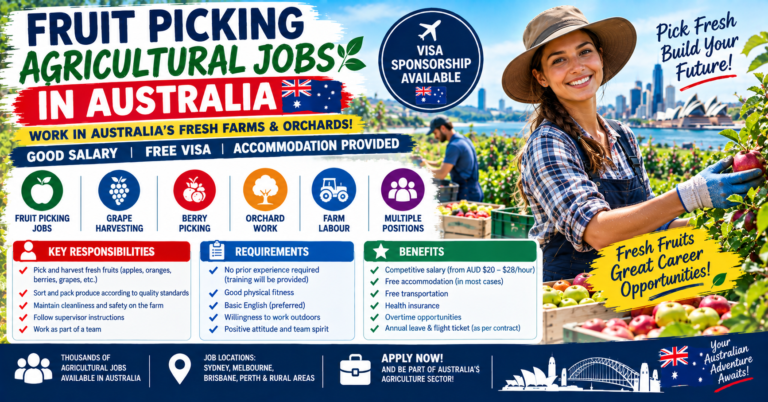
Fruit Picker Jobs in Australia
Fruit Picker Jobs in Australia As of 21 May 2026, fruit-picking work in Australia is usually not “visa sponsorship” in the normal skilled-work sense. Most farms want you to already have work rights — commonly a Working Holiday / Work and Holiday visa, or you come through the PALM scheme if you’re from an eligible Pacific country or Timor-Leste. Home Affairs says Working Holiday Maker visa holders can work in agriculture, and agriculture/harvest vacancies can be searched on the official Workforce Australia jobs board. 1
Best visa options for fruit picking
- Working Holiday visa 417 / Work and Holiday visa 462
Good if your passport country is eligible. These visas allow young adults from partner countries to holiday in Australia and do short-term work. 2
Fruit picking/agriculture work can also help qualify for a second or third WHM visa if you complete the required specified work. 1 - PALM scheme — real “sponsored” seasonal pathway
If you are from one of the 9 participating Pacific island countries or Timor-Leste, PALM lets eligible workers take jobs in Australia; employers can recruit for seasonal jobs up to 9 months or longer-term roles from 1 to 4 years. You apply through your country’s Labour Sending Unit, not by paying agents online. 3 - Employer sponsorship / labour agreement roles
Basic “fruit picker” sponsorship is uncommon. Sponsorship is more realistic for related roles such as horticulture supervisor, grower, irrigation worker, forklift driver, machinery operator, truck driver, farm manager, etc. Australia’s Horticulture Industry Labour Agreement lists approved horticulture occupations, but it does not simply list “fruit picker” as a standard sponsored role. 4
Where to search
- Workforce Australia jobs board — official job board recommended by Home Affairs for agriculture/harvest vacancies. 1
- SEEK — search terms:
fruit picking visa sponsorship,farm work visa sponsorship,482 horticulture,seasonal farm worker. SEEK currently has search pages for fruit-picking/visa-sponsorship jobs, but check each ad carefully because many require existing work rights. 5 - Farm Work Australia — lists fruit picking, harvest, backpacker and farm jobs across Australian states. 6
- Direct growers — for example, Nutrano accepts seasonal farm-worker/fruit-picker applications but says applicants need a valid working visa and usually their own transport/accommodation; Piñata Farms lists seasonal roles and welcomes Working Holiday Visa holders. 7
Pay and rights
For adult casual fruit/vegetable pickers paid hourly, Fair Work says the minimum is $30.35/hour as of 1 July 2025. If you’re paid by piece rate, you still have a minimum wage guarantee, and the piece rate must allow a competent average worker to earn at least 15% above the relevant hourly rate. 8
Be careful: do not pay anyone upfront for a job or visa, don’t give your passport to an employer/agent, and don’t work on a Visitor visa or ETA — Home Affairs says visitor/ETA holders cannot work in Australia. 9
Quick application checklist
When applying, include:
- your nationality and current location
- visa you hold or plan to apply for
- availability dates
- preferred state/region
- whether you have transport and accommodation
- farm/packing/forklift/driver experience if any
- physical fitness for outdoor work
If you tell me your nationality, age, current country, and whether you already have an Australian visa, I can suggest the most realistic visa route and search terms for you.
Major Companies and Farms Hiring Seasonal Workers
Rather than applying to thousands of tiny farms, many backpackers and seasonal workers find success applying directly to Australia’s massive corporate agriculture companies, or the major labour-hire agencies that staff them.
Corporate Growers (Apply Directly):
- Costa Group: Australia’s largest grower, packer, and marketer of fresh fruit and vegetables. They have over 60 farms across the country. They frequently hire for 2026/2027 seasons for berries (Corindi NSW, Tasmania, Gingin WA), tomatoes (Guyra NSW glasshouses), and citrus (Mildura VIC, Renmark SA).
- Piñata Farms: A massive producer of pineapples, strawberries, and mangoes with locations in Queensland, the Northern Territory, and Tasmania. They are very accustomed to hiring Working Holiday Makers.
- Nutrano Produce Group: Major growers of citrus and tropical fruits, particularly in the Northern Territory, Queensland, and Victoria.
- Perfection Fresh: Known for tomatoes, berries, and mangoes, they operate large glasshouses and farms (such as their massive glasshouse in Two Wells, SA) and frequently need crop workers and packers.
Major Labour-Hire Agencies (Specialists in Farm Work):
- Agri Labour Australia: One of the best avenues for foreigners. They place thousands of candidates in harvest jobs (berries, citrus, cotton, sugarcane, and nuts like almonds and macadamias). They ensure you are paid legally and their jobs usually qualify for 2nd/3rd year visa extensions.
- MADEC: A non-profit community organization that manages the official Harvest Trail services for the Australian government. They connect workers with growers who have been vetted for fair practices.
- Linx Employment: Highly active in Tasmania (especially for the summer cherry harvest with companies like Reid Fruits).
Note: For a different type of harvest, CBH Group (Western Australia) and Viterra (South Australia/Victoria) hire thousands of seasonal workers every year from October to January for the grain harvest. Roles include grain samplers and weighbridge operators.
2. Types of Jobs Available
When people say “fruit picking,” they are usually referring to a whole ecosystem of harvest jobs. Depending on your English level, physical fitness, and licenses, you can apply for:
- Fruit Pickers: The most common role. Very physically demanding. It involves working outdoors, climbing ladders, carrying heavy picking bags (like for citrus or apples), or bending over all day (strawberries).
- Pack Shed Workers / Packers: Working indoors on an assembly line. You will sort, grade, and pack fruit into punnets or boxes. It is less physically intense than picking, but highly repetitive and requires you to stand on your feet all day.
- Crop Workers / Pruners: Working in high-tech glasshouses (like Costa’s tomato farms) or orchards. Tasks involve pruning, thinning vines, de-leafing, and general plant maintenance.
- Quality Control (QC) Officers: Checking the fruit for blemishes, size, and weight as it comes into the packhouse. Requires good attention to detail and better English skills.
- Harvest Machinery Operators / Forklift Drivers: If you hold an Australian Forklift ticket or have tractor experience, you can get paid a higher hourly rate moving pallets of fruit from the fields to the cold storage, or driving bank-out wagons during nut harvests.
3. Current & Upcoming 2026 Harvest Seasons
Australia is huge, so harvest work follows the sun. You can chase the seasons year-round:
- May to August (Winter): Citrus picking (oranges, mandarins, lemons) in South Australia (Riverland) and Victoria (Sunraysia/Mildura). Berry picking in northern NSW (Corindi) and Queensland. Tomato glasshouse work (year-round but peaks in winter) in NSW and SA.
- September to November (Spring): Mangoes kick off in the Northern Territory and move down into Queensland. Berry seasons ramp up in WA and southern states.
- December to February (Summer): The famous Tasmanian cherry harvest happens now (very lucrative but short). Stone fruit (peaches, nectarines) in Victoria and NSW. Grapes in SA and WA.
- March to May (Autumn): Apples and pears in Victoria (Goulburn Valley), Western Australia, and Tasmania.
4. What You Need to Get Hired
Most legitimate employers and agencies will require the following before you can start:
- A Valid Visa: As mentioned previously, Working Holiday (417/462) or a PALM scheme visa.
- Tax File Number (TFN): You must provide this so you are taxed correctly.
- Australian Bank Account: Companies pay weekly or fortnightly via direct deposit.
- Superannuation Account: A retirement fund account where your employer pays your mandatory super contributions (currently 11.5% on top of your wage).
- Transport & Accommodation: Many farms are isolated. Having an international driver’s license and your own vehicle is a massive advantage. While some agencies provide basic hostel accommodation, many require you to arrange your own stay in a nearby working hostel, caravan park, or Airbnb.
- Physical Fitness: Job ads will explicitly ask that you are fit enough to walk, bend, and lift for 8–10 hours a day in hot, humid, or dusty conditions.
Apply Now || Apply Now || Apply Now ||
Market Size & Growth Forecasts
- The sector was valued at approximately AUD 158 billion in 2025 and is projected to expand at a CAGR of 5.7% from 2026 to 2035, potentially reaching AUD 275 billion by 2035.1
- Alternative forecasts show a 7% CAGR from 2025–2030, with the market growing from US$130.4 billion (2024) to US$196.2 billion by 2030.2
- Freight & logistics specifically: USD 103.2 billion in 2026, growing at 4.16% CAGR to USD 126.5 billion by 2031.3
Key Growth Drivers
- E-commerce surge — Record household penetration (>82%) and online spending are fuelling demand for last-mile delivery, warehousing, and distribution.
- Infrastructure investment — The $14.5 billion Inland Rail project and port automation are cutting costs and shifting freight from road to rail.
- Technology & sustainability — Rapid adoption of AI, warehouse automation, IoT, and green logistics (electric trucks, low-carbon warehousing).
- Capital flows — ~$38 billion in targeted investment for Australian logistics assets, with rental growth expected to replace yield compression in 2026.
Employment & Job Outlook
The Transport, Postal & Warehousing industry employs around 750,000 people and grew 2.1% in the year to February 2026.4
- Warehousing & storage employment has risen 23% since 2020.
- Persistent shortages of truck drivers (national deficit projected at 26,000 by 2030), forklift operators, warehouse staff, freight forwarders, and logistics coordinators.
- Job ads in road transport and rail/maritime are up 21–28% year-on-year.
This creates real opportunities for visa sponsorship in skilled or semi-skilled logistics roles (e.g., truck driver, warehouse supervisor, supply-chain analyst) under the 482 TSS visa or labour agreements, especially in regional areas.
Outlook for 2026 and Beyond
2026 is expected to see improved capital deployment, stronger rental growth, and continued automation investment. Geopolitical risks and freight volatility remain, but Australia’s logistics market is viewed as one of the most stable and attractive in the Asia-Pacific.
Would you like me to connect this to specific job roles, companies hiring in logistics, or visa sponsorship pathways (similar to the fruit-picking info)? Just share your nationality, experience, or preferred location and I’ll tailor it!
Australia’s logistics sector (as of May 2026) offers significantly higher and more stable salaries than seasonal fruit-picking roles, driven by acute labour shortages — especially truck drivers — and strong structural demand from e-commerce and infrastructure growth.
Salary Reality vs Demand
Entry-to-mid level logistics roles consistently pay 30–80% more than typical fruit-picking earnings:
- Fruit picker:
$23–$28/hour or piece-rate ($900–$1,200/week on good days; annual average ~$49k).1 - Logistics Coordinator / Associate: $81k–$85k average.2
- Warehouse / Transport roles: $65k–$95k junior-to-mid.
- Logistics / Supply Chain Analyst: $80k–$95k (seniors $100k–$128k).3
- Logistics Manager: $110k–$130k.4
- Warehouse / Transport Manager: $90k–$130k mid-level; seniors up to $155k–$170k.5
Demand is extremely high:
- Truck driver shortage: ~28,000 unfilled positions now, forecast to reach 78,000 by 2029.
- 80% of road-freight operators report unfilled roles.
- Transport, Postal & Warehousing industry employs
750,000 people and grew 2.1% in the past year, with median weekly earnings of $1,608 ($83.6k annually).6
Skilled logistics roles (truck driving, warehouse supervision, supply-chain coordination) face the strongest demand, creating real opportunities for visa sponsorship under 482 TSS visas or labour agreements, particularly in regional areas.
Key Takeaways
- Salary uplift is substantial — moving from fruit picking into logistics can more than double your earnings once you gain experience or qualifications (e.g., heavy vehicle licence, forklift ticket, or supply-chain skills).
- Demand outstrips supply in operational roles, leading to faster hiring, overtime opportunities, and upward pressure on wages.
- Stability & progression far exceed seasonal harvest work — logistics offers year-round employment with clear career paths into management.
- Visa sponsorship potential is higher for logistics than basic fruit picking, especially for drivers and supervisors.
- Regional premiums apply — roles outside major cities often pay more and are more likely to offer sponsorship.
Conclusion
The logistics sector in Australia is a stronger long-term option than fruit picking for both earnings and career growth. With persistent driver and warehouse shortages alongside continued e-commerce and infrastructure expansion, 2026–2030 looks like a golden window for job seekers — particularly those on Working Holiday visas or seeking employer-sponsored pathways. Salaries are realistic and competitive, and demand is genuine rather than hype.
FAQs
Q: Can I get visa sponsorship in logistics more easily than fruit picking?
Yes — especially for truck drivers, warehouse supervisors, and logistics coordinators under the 482 visa or regional labour agreements. Basic fruit-picker roles rarely offer sponsorship.
Q: What’s the realistic starting salary for a new entrant in logistics?
$65k–$85k for coordinators or warehouse staff; $90k+ once you hold a heavy vehicle licence or relevant experience.
Q: How bad is the truck driver shortage really?
Severe — 28,000 short now and projected to triple by 2029 due to an ageing workforce and rising freight volumes.
Q: Do logistics roles pay better than fruit picking long-term?
Absolutely. Even mid-level logistics roles exceed typical annual fruit-picking income by $30k–$60k+ with far better conditions and hours.
Q: Where should I look for logistics jobs right now?
SEEK, Workforce Australia, Randstad, and specialist recruiters like Agri Labour or Dayjob Recruitment. Filter for “truck driver”, “warehouse”, or “logistics coordinator”.
Want me to compare specific roles (e.g., truck driver vs berry picker), check sponsorship-friendly companies, or tailor this to your nationality/experience? Just let me know!