Cleaners Jobs in Czech Republic
Cleaning jobs in the Czech Republic have quietly evolved into one of the country’s most important employment sectors for foreign workers. From Prague’s luxury hotels and modern office buildings to industrial warehouses in Brno and Ostrava, cleaners now form an essential workforce supporting the country’s rapidly expanding economy. For many migrants arriving from Asia, Eastern Europe, and developing economies, these jobs provide not only wages but also a legal pathway into Europe’s labor market.
The Czech Republic has maintained one of the lowest unemployment rates in Europe for years, creating labor shortages across service industries. As Czech companies struggled to hire local workers for physically demanding roles, employers increasingly turned toward international recruitment. Cleaning positions became especially attractive because they often required minimal qualifications, limited language skills, and offered immediate employment opportunities.
For thousands of workers, cleaning jobs represent financial survival and future ambition at the same time. Some employees hope to save money for families back home. Others aim to secure long-term residency or transition into better-paying industries after gaining experience inside the Czech labor market. The sector has therefore become far more than temporary manual labor. It now operates as a gateway into broader economic mobility.
Yet behind the promise of steady work lies a demanding reality shaped by long shifts, rising housing costs, physically exhausting routines, and uncertain career advancement. The story of cleaners in the Czech Republic reflects a much larger story about migration, labor shortages, and the hidden workforce sustaining modern European cities.
Companies & Job Info
EWI Recruitment – Short Details
Company Name: EWI Recruitment
Industry: International recruitment and staffing
Head Office: London, United Kingdom
Founded: 2011
Work Type: Overseas jobs and workforce hiring
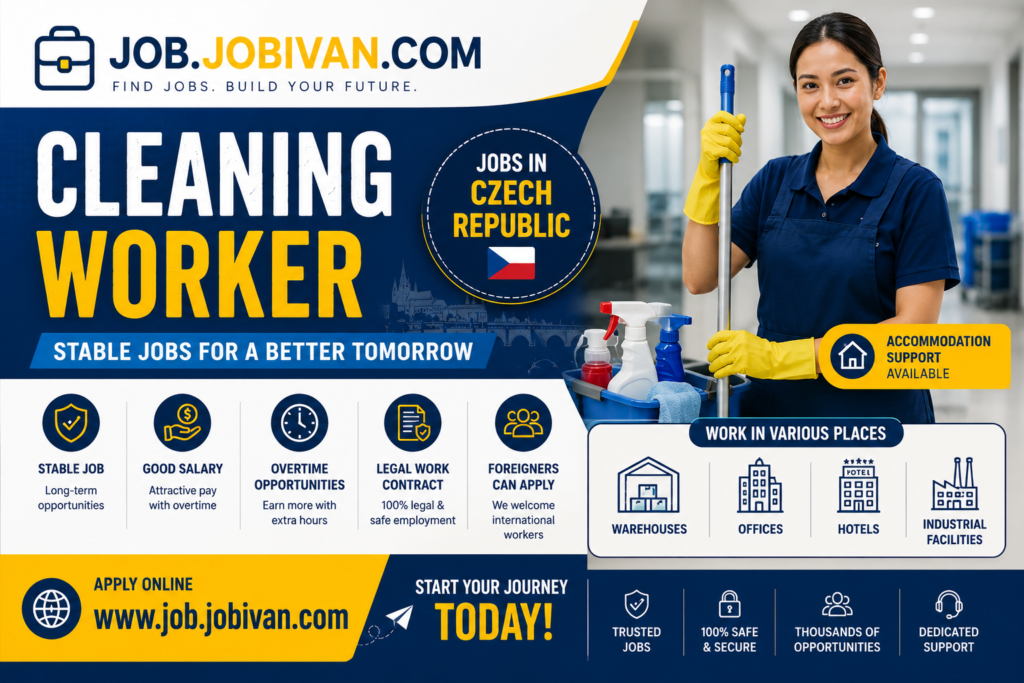
Cleaning Worker Job in Czech Republic
- Location: Czech Republic
- Job Type: Full-time cleaning work
- Work Areas: Warehouses, offices, hotels, and industrial facilities
- Benefits:
- Stable salary
- Overtime available
- Accommodation support
- Legal work contract
- Foreign workers accepted
Official Website
General Contact
- Email: hello@ewirecruitment.com
- Phone: +44 (0) 207 877 8350
The Growth of Cleaning Jobs in the Czech Republic
The expansion of cleaning jobs is closely tied to the Czech Republic’s economic transformation during the past decade. Industrial growth, tourism, logistics expansion, and international investment created enormous demand for maintenance and sanitation services. Every new office complex, hotel, warehouse, hospital, and shopping center required continuous cleaning operations.
Prague became the center of this transformation. Tourism growth increased pressure on hotels and hospitality businesses to maintain international standards of cleanliness. At the same time, multinational companies opened corporate offices requiring overnight cleaning crews and facility maintenance teams.
Industrial cities experienced similar changes. Manufacturing plants and logistics centers operating twenty-four hours a day required constant sanitation and waste management. Cleaning services therefore became integrated into the country’s industrial infrastructure rather than remaining a secondary support function.
The COVID-19 pandemic further accelerated the importance of sanitation work. Businesses, hospitals, schools, and transportation systems intensified cleaning procedures, increasing both hiring and public awareness of hygiene workers. Although public attention faded after the pandemic, the demand for cleaners remained permanently elevated.
Today, cleaning companies recruit workers year-round. Many positions are filled through labor agencies specializing in foreign employment, accommodation arrangements, and visa support. What once seemed like low-status temporary work has gradually become one of the Czech Republic’s most stable employment sectors.
Why Foreign Workers Choose Cleaning Jobs
Foreign workers are drawn toward cleaning jobs for several practical reasons. Unlike highly skilled professions, most cleaning positions require limited formal education and minimal previous experience. Employers typically prioritize reliability, physical endurance, and flexibility rather than technical qualifications.
For migrants entering Europe for the first time, this accessibility matters enormously. Cleaning work often allows employees to secure contracts quickly and begin earning immediately. Some employers also provide accommodation assistance, transportation, or support with legal documentation.
Many workers see these jobs as stepping stones rather than permanent careers. A cleaner arriving in Prague may eventually move into warehouse operations, manufacturing, hospitality management, or customer-service roles after improving language skills and adapting to the local environment.
Economic differences between the Czech Republic and workers’ home countries also influence migration decisions. Even modest Czech wages can significantly exceed average salaries in parts of Asia, Eastern Europe, or Africa. Remittances sent home therefore become financially meaningful for entire families.
Still, migration involves sacrifice. Workers frequently leave spouses, children, or parents behind for extended periods. Shared housing, physically demanding shifts, and social isolation become common parts of everyday life. The opportunity for higher earnings exists alongside emotional and personal costs that are rarely visible in recruitment advertisements.
What Cleaning Work Actually Involves
The public often imagines cleaning work as simple janitorial labor, but the reality is much broader and more physically demanding. Cleaning employees in the Czech Republic work across multiple industries, each requiring different routines and responsibilities.
Hotel cleaners typically handle guest rooms, bathrooms, laundry services, and hallway maintenance. Their schedules often depend on tourism patterns and hotel occupancy rates. During busy seasons, workers may clean dozens of rooms per shift under strict time pressure.
Office cleaning crews usually work during evenings or overnight hours after employees leave buildings. Tasks include vacuuming, disinfecting surfaces, emptying waste bins, and maintaining common areas.
Industrial cleaning represents one of the sector’s toughest divisions. Workers in warehouses and factories manage heavy equipment, floor-cleaning machines, dust removal, and sanitation procedures in physically intense environments.
Hospital cleaning requires strict adherence to hygiene protocols and disinfectant procedures. Employees must maintain sanitation standards essential for public health and patient safety.
Construction cleaning has also become increasingly common as urban development expands. Workers clean newly completed buildings, remove debris, polish surfaces, and prepare properties for occupancy.
Major Cleaning Sectors in the Czech Republic
| Sector | Main Duties | Work Environment |
|---|---|---|
| Hotels | Room cleaning, laundry, sanitation | Fast-paced hospitality |
| Offices | Surface cleaning, waste disposal | Evening and night shifts |
| Warehouses | Machine cleaning, dust removal | Industrial environments |
| Hospitals | Hygiene and disinfecting | Strict sanitation rules |
| Construction Sites | Debris removal, polishing | Temporary project work |
The physical demands remain one of the industry’s defining characteristics. Long hours standing, repetitive movement, chemical exposure, and constant time pressure create significant exhaustion for many workers.
Wages and Living Conditions
Cleaning salaries in the Czech Republic vary depending on location, overtime availability, specialization, and employer quality. Prague generally offers the highest wages because living expenses are also significantly higher than elsewhere in the country.
Entry-level cleaners commonly earn hourly wages that provide modest but stable income. Workers willing to accept overtime shifts can substantially increase monthly earnings, particularly in industrial facilities operating continuously.
Accommodation costs remain one of the biggest financial challenges. Many migrant workers live in shared dormitories or company-arranged housing to reduce expenses. Shared rooms with multiple coworkers are common, especially near industrial zones and large cities.
Despite these difficulties, many employees still view Czech wages positively when compared with economic conditions in their home countries. Consistent income, legal contracts, and relatively stable employment create a sense of security that may not have existed previously.
Typical Conditions for Cleaning Workers
| Job Type | Common Schedule | Physical Demand | Housing Support |
|---|---|---|---|
| Hotel Cleaning | Morning to afternoon | Moderate to high | Limited |
| Warehouse Cleaning | Rotating shifts | High | Frequently available |
| Office Cleaning | Evening or overnight | Moderate | Sometimes available |
| Construction Cleaning | Long daytime shifts | Very high | Often included |
Some workers eventually improve their financial situations by learning Czech, gaining experience, or moving into supervisory positions. Others remain trapped in low-wage cycles due to limited language skills or lack of career advancement opportunities.
The Role of Recruitment Agencies
Recruitment agencies have become central to the Czech cleaning industry. These agencies connect employers with foreign workers and often manage transportation, accommodation, contracts, and visa procedures simultaneously.
For employers, agencies solve labor shortages quickly. For migrants, agencies simplify relocation into an unfamiliar country. Many workers depend entirely on recruiters during the migration process.
However, the system also creates vulnerabilities. Some agencies operate transparently and professionally, while others may impose hidden fees, overcrowded accommodation, or misleading employment promises. Workers unfamiliar with Czech labor regulations sometimes struggle to defend their rights effectively.
Dependence on employer-sponsored visas can further complicate matters. Employees worried about losing residency status may hesitate to report abusive conditions or unpaid wages.
Despite these risks, recruitment agencies continue expanding because demand for labor remains extremely high. As long as Czech businesses struggle to hire local workers for physically demanding positions, international recruitment will likely remain essential to the sector’s survival.
Language Barriers and Integration
One reason cleaning jobs remain accessible is that they often require only limited Czech-language ability. Many workplaces rely on visual instructions, multilingual supervisors, or translation apps to coordinate daily tasks.
Still, language barriers shape workers’ lives in powerful ways. Employees who cannot communicate effectively in Czech may struggle with contracts, healthcare access, transportation systems, or housing negotiations. Everyday activities become more difficult when communication remains limited.
Language also influences career mobility. Workers who improve their Czech skills often gain access to better positions, supervisory responsibilities, or entirely different industries. Those unable to learn the language frequently remain in low-paying manual jobs for longer periods.
Social integration becomes another challenge. Foreign workers sometimes live and work primarily among people from their own countries, limiting opportunities to engage with Czech society more broadly. Isolation can become especially severe outside major cities where English is less common.
Some employers have started encouraging basic language education because communication problems affect productivity and workplace safety. However, consistent language support remains uneven across the industry.
Women in the Cleaning Workforce
Women represent a major part of the Czech cleaning workforce, especially in hospitality and residential services. Hotels across Prague and tourist destinations rely heavily on female cleaners to maintain guest accommodations and public areas.
For many women migrants, these jobs provide economic independence and the ability to support relatives abroad. Some arrive alone while others migrate alongside spouses already employed in construction or industrial sectors.
The work, however, involves significant physical strain. Repetitive movement, lifting heavy linens, prolonged standing, and strict performance targets create long-term health pressures. Hotel housekeeping is particularly demanding because room-cleaning quotas are often tied directly to shift performance.
Women in low-wage service industries may also face greater vulnerability to exploitation, harassment, or unstable scheduling. Shared accommodation and employer dependency sometimes intensify these risks.
Despite the challenges, female migrant communities have become deeply established within parts of the Czech labor market. Informal support networks frequently help new arrivals find housing, employment information, and emotional support during difficult transitions.
Automation and the Future of Cleaning Work
Technology is beginning to reshape the cleaning industry across Europe, including in the Czech Republic. Automated floor-cleaning machines and robotic sanitation systems now appear in airports, shopping centers, hospitals, and logistics facilities.
Some employers view automation as a response to labor shortages rather than a replacement for human workers. Machines can handle repetitive tasks efficiently, allowing employees to focus on more detailed cleaning responsibilities.
Industrial warehouses especially have begun integrating autonomous cleaning systems capable of operating continuously with minimal supervision. However, human labor remains essential for irregular environments, hospitality services, sanitation compliance, and detail-oriented work.
The future of cleaning employment may therefore involve adaptation rather than disappearance. Workers capable of operating or maintaining advanced equipment could gain access to better-paying technical roles inside the sector.
At the same time, low-skilled manual cleaning positions are unlikely to vanish completely in the near future. Human flexibility and judgment remain difficult to replace in many real-world environments.
The Invisible Workforce Supporting Modern Cities
Cleaning workers remain among the least visible employees sustaining urban life. Office workers enter sanitized buildings each morning without seeing the overnight crews responsible for maintaining them. Hotel guests rarely consider the labor behind spotless rooms and polished hallways.
Yet modern economies depend on this invisible workforce every single day.
The Czech Republic’s economic success increasingly relies on migrants willing to perform physically demanding jobs that many local workers avoid. Cleaning services have therefore become part of a broader European conversation about migration, labor shortages, and economic inequality.
Without cleaners, hospitals would struggle to maintain hygiene standards, hotels could not operate effectively, factories would face sanitation issues, and office complexes would deteriorate rapidly. Their work forms an essential foundation beneath modern urban infrastructure.
Despite this importance, public recognition remains limited. Cleaning workers often operate during nights, early mornings, or behind closed doors, making their labor largely unseen.
Their story reveals how global migration and local economic demand intersect in practical everyday life. Behind every polished floor and disinfected workspace stands a workforce carrying the physical burden of maintaining modern society.
Takeaways
- Cleaning jobs in the Czech Republic have become essential to the country’s economy.
- Foreign workers fill many positions because of long-term labor shortages.
- Prague offers the largest number of opportunities but also the highest living costs.
- Cleaning work includes hotels, offices, warehouses, hospitals, and construction sites.
- Recruitment agencies play a major role in hiring and relocation processes.
- Language skills strongly influence long-term career advancement opportunities.
- Automation may change the industry, but human labor remains essential.
Conclusion
Cleaning jobs in the Czech Republic represent far more than simple manual labor. They reflect the realities of modern migration, labor shortages, economic ambition, and the hidden systems sustaining urban life. For thousands of foreign workers, these positions provide a chance to earn stable income, support families, and establish a future inside Europe’s labor market.
The industry continues growing because the country’s economy depends heavily on service workers willing to perform physically demanding tasks. Hotels, hospitals, warehouses, offices, and residential buildings all rely on cleaners whose labor often remains invisible to the public.
At the same time, the sector reveals ongoing challenges involving housing costs, worker protections, language barriers, and social integration. Economic opportunity exists alongside physical exhaustion and uncertain mobility.
As the Czech Republic continues evolving economically, cleaning workers will remain deeply connected to the country’s future. Their contribution extends far beyond sanitation alone. They help sustain the infrastructure of everyday life, ensuring that modern cities continue functioning smoothly, safely, and efficiently.
FAQs
Are cleaning jobs in the Czech Republic easy to get?
Yes. Many employers regularly hire foreign workers because labor shortages continue across service industries.
Do cleaners need to speak Czech?
Not always. Many entry-level jobs require minimal Czech language skills, though learning the language improves future opportunities.
Which city has the most cleaning jobs?
Prague offers the largest number of cleaning positions due to tourism, business offices, and large commercial infrastructure.
Is accommodation included with cleaning jobs?
Some employers or recruitment agencies provide shared accommodation or housing assistance for foreign workers.
Can cleaning jobs lead to other careers?
Yes. Many workers eventually move into warehouse operations, hospitality management, logistics, or supervisory positions after gaining experience and language skills.