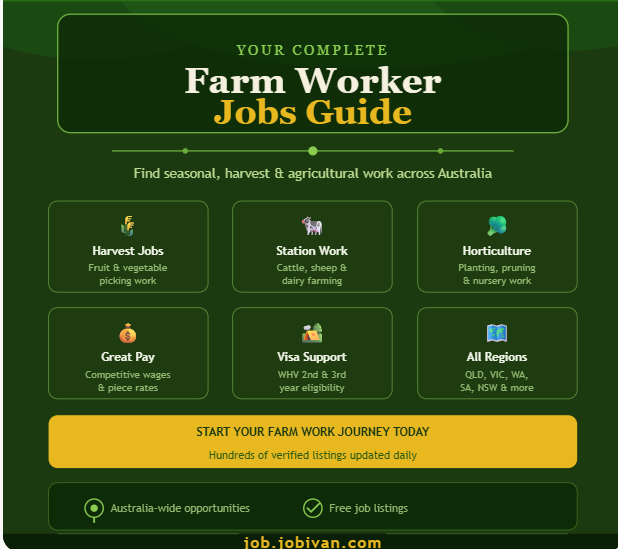
Farm Worker Jobs in Australia Guide
Farm worker jobs in Australia offer a mix of opportunity, mobility, and challenge, attracting both local and international workers each year. These roles include fruit picking, livestock care, machinery operation, and general farm labor, forming the backbone of a sector that feeds both domestic markets and global exports. For job seekers, the appeal lies in relatively high wages compared to many countries, flexible entry requirements, and potential visa extensions or migration pathways.
At the same time, the reality is more complex. Agricultural work is physically demanding, often seasonal, and typically located in remote areas. Workers may face long hours, extreme weather, and varying living conditions. Australia’s reliance on migrant labor—especially through working holiday visas and Pacific labor programs—has created a system where opportunity and vulnerability coexist.
Understanding farm worker jobs in Australia requires looking beyond the surface. It involves examining wages, visa systems, regional life, and the broader economic role of agriculture. This article explores those dimensions in depth, offering a clear, structured view of what it means to work on Australian farms today.
The Structure of Australia’s Agricultural Labor Market
Australia’s agricultural labor market is shaped by seasonality, geography, and policy. Unlike urban industries, farming depends heavily on planting and harvest cycles, creating fluctuating demand for workers throughout the year. During peak seasons, farms require large numbers of laborers in a short time, which local populations alone cannot supply.
To address this, Australia relies on a layered workforce. Backpackers on working holiday visas often take short-term farm jobs to extend their stay. Structured programs bring in workers from Pacific nations for seasonal and longer-term roles. Skilled migrants fill positions requiring technical expertise or management experience.
This system varies across regions. In horticulture-heavy areas, demand for seasonal labor is intense and repetitive. In livestock regions, the need is more stable but requires different skills. The result is a dynamic labor market that depends on mobility, flexibility, and migration policy.
Jobs Information & Companies
ruit Farm Worker- job post
Dimbulah QLD 4872
$69,000 – $85,000 a year – Full-time
Fruit Farm Worker- job post
Red Cliffs VIC 3496
$75,000 – $77,000 a year – Permanent, Full-time
Poultry Farm Worker- job post
3.73.7 out of 5 stars
Nathalia VIC 3638
$77,000 – $80,000 a year – Full-time
Tomato Picking, Packing, and Crop Work Roles- job post
3.63.6 out of 5 stars
Guyra NSW 2365
$30.80 an hour – Full-time
Farm Hand- job post
Katunga VIC 3640
$24 – $35 an hour – Permanent, Full-time
Farm Hand/Labourer- job post
Murrumbateman NSW
$30 – $32 an hour – Full-time, Casual
Crop Worker- job post
Premier Fresh Australia Pty Ltd
Lancaster VIC
Casual
Farm Hand- Fruit Picker 1 Month Only- job post
NORTEC Employment & Training Limited
1.41.4 out of 5 stars
Alstonville NSW 2477
$30.00 – $30.35 an hour – Temporary, Casual
Types of Farm Worker Jobs in Australia
Farm work in Australia includes a wide range of roles beyond the commonly known fruit picking jobs. Each position comes with different responsibilities, skill requirements, and earning potential.
| Job Type | Typical Tasks | Skill Level | Average Hourly Pay (AUD) |
|---|---|---|---|
| Fruit Picker | Harvesting crops, sorting produce | Low | $23–$28 |
| Farmhand | General labor, maintenance, animal feeding | Medium | $25–$32 |
| Machinery Operator | Operating tractors and harvest equipment | High | $30–$40 |
| Livestock Worker | Animal care, herding, monitoring health | Medium | $26–$35 |
| Supervisor | Team management, planning, logistics | High | $35–$50 |
Fruit picking remains the most accessible entry point, often requiring no prior experience. However, it demands physical stamina and the ability to work long hours outdoors. Higher-skilled roles, such as machinery operation, require training but offer better pay and stability.
Wages, Conditions, and Legal Protections
Farm worker wages in Australia are regulated under national workplace laws, including minimum wage standards and industry awards. Recent reforms introduced hourly pay guarantees for workers previously paid solely by output, improving income stability for many laborers.
Despite these legal frameworks, enforcement challenges remain. Some workers, particularly migrants, may not fully understand their rights or may hesitate to report issues due to job security concerns. Language barriers and dependence on employers for visas can further complicate matters.
Working conditions vary widely. Some farms provide accommodation, meals, and transportation, while others leave workers responsible for their own arrangements. Physical demands are significant, with tasks often performed in extreme weather conditions.
Visa Pathways and Migration Programs
Migration plays a central role in Australia’s agricultural workforce. Several visa options allow foreign workers to participate in farm jobs, each with its own benefits and limitations.
| Visa Type | Duration | Key Benefits | Limitations |
|---|---|---|---|
| Working Holiday Visa | Up to 3 years | Travel flexibility, easy entry | Temporary, limited stability |
| Seasonal Worker Programme | Up to 9 months | Structured work, employer support | Restricted eligibility |
| PALM Scheme | Up to 4 years | Longer-term employment, higher earnings | Tied to specific employers |
| Skilled Migration Visas | Long-term | Career growth, residency pathways | Requires qualifications |
The Working Holiday visa remains popular among young travelers, while structured labor schemes help address workforce shortages. Migration policy continues to evolve to balance labor needs with worker protections.
Regional Realities and Living Conditions
Farm work in Australia often takes place in rural and remote areas, far from major cities. These locations offer unique experiences but also present challenges such as limited healthcare, transport, and housing options.
Accommodation is a major concern. Some employers provide housing, while others require workers to find their own, often in competitive rural markets. Social isolation can also affect workers, particularly those far from family and familiar environments.
Despite these challenges, many workers find value in the experience, forming strong connections and gaining exposure to different cultures and lifestyles within rural Australia.
Economic Importance of Farm Workers
Farm workers are essential to Australia’s agricultural success. The sector contributes tens of billions of dollars annually to the economy, with exports forming a significant portion. Without sufficient labor, crops cannot be harvested efficiently, leading to financial losses.
Labor shortages have demonstrated how critical this workforce is. Unharvested produce and disrupted supply chains can impact both domestic markets and international trade. Farm workers also contribute to regional economies through local spending and community engagement.
Reforms and the Future of Agricultural Work
Australia has introduced reforms aimed at improving fairness, including clearer wage rules and stronger enforcement. These changes aim to protect workers while maintaining a reliable labor supply for farmers.
Technology is gradually transforming agriculture, with automation reducing reliance on manual labor in some areas. However, many tasks still require human effort, especially in smaller or specialized farms.
Climate change is also influencing the sector, affecting crop cycles and working conditions. The future of farm work will depend on how effectively Australia adapts to these environmental and economic shifts.
Takeaways
- Farm worker jobs are vital to Australia’s agricultural economy
- Migrant labor is essential for meeting seasonal demand
- Wages are regulated but vary depending on role and employer
- Visa programs create both opportunities and challenges
- Rural living conditions influence worker experiences
- Labor shortages impact production and the wider economy
- Future changes will be driven by technology and climate factors
Conclusion
Farm worker jobs in Australia highlight a sector shaped by both opportunity and complexity. They provide accessible employment and pathways for international workers while supporting a critical part of the national economy. At the same time, they demand physical resilience and awareness of working conditions.
As policies evolve and new challenges emerge, the agricultural workforce will remain central to Australia’s future. Ensuring fair conditions, sustainable practices, and economic stability will be key to maintaining this balance. The experiences of farm workers—diverse and essential—will continue to define the industry in the years ahead.
FAQs
What qualifications are needed for farm jobs in Australia?
Most entry-level roles require no formal qualifications, though skilled positions may need training or certifications.
Are farm jobs in Australia suitable for foreigners?
Yes, many roles are filled by international workers through visa programs.
How long do farm jobs usually last?
They are typically seasonal, lasting from weeks to several months.
Do farm workers get paid hourly or per output?
Both systems exist, but minimum hourly protections are now enforced.
Is farm work physically demanding?
Yes, it involves manual labor, long hours, and outdoor conditions.